
The Eagle River Chain Remains a Great Fishery
I recently spent a week fishing on the Eagle River Chain in northern Wisconsin. While I wandered around the lakes, I recalled some great memories, and realized that Eagle River is where I have taken family vacations since about 1965. I have fished nearly every inch of that chain since I was a kid. You have had to live on the lakes, or been a guide on the lakes, to top the number of hours that I have experienced on that water.
Definite changes have occurred over the years—some good, some not so good. Let’s go through a summary of the Eagle River Chain and where we are today. It’s still a great place to spend a week and catch a variety of fish.
The Eagle River Chain is a flowage. The ten interconnected lakes total roughly 3,600 acres, with about 14 miles of water from end to end. The water is constantly moving; sometimes, more than others, depending on recent rainfall. You can’t really see that the water is moving until you get into one of the lake’s connecting channels. If you get up close to one of the no-wake buoys, you often see a seam of water right behind the downstream side. But in general, you can’t tell it’s moving.
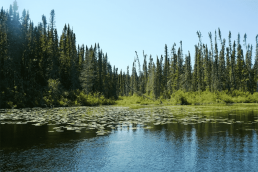
Water clarity is one of the first noticeable differences in the past 50 years. The water isn’t dirty, but it isn’t clear, either. Back in the day, if you were standing in the water up to your knees, you couldn’t see your feet. It was very tannic-stained, root-beer-colored water. It still is, but for some reason, not to that degree anymore. Back then, there was never water too shallow to fish. Muskies would sit along the bank in two feet of water near a fall-down or other structure.
Now, the water is clearer, and things have changed a little. You don’t see that super-shallow bite for the muskies. Back then, you could catch walleyes in 6 feet of water in the middle of the day. Muskies will still be shallow from time to time, but the walleye bite likely starts in 8 to 10 feet of water and deeper.
 The chain has always been a summer destination. There were resorts and boat-up restaurants on every lake. During the day, it was busy with tubers and water skiers. Well, that still holds true and has at least doubled, but there are ways to get around it. The center of the chain, from Yellow Birch through Eagle Lake, can get very busy in the summer, with water sports and pontoon cruising. But don’t let that scare you. There are plenty of areas off the beaten path that are very peaceful, even on summer days and weekends.
Let’s start with the two ends of the chain—my two favorites. At the south end lies a gem, 920-acre Cranberry Lake. In the center of Cranberry, a giant island providing endless shoreline to cast for bass or muskies. It’s also one of my favorites for perch and crappies among any of the shallow weeds in 8 to 10 feet of water. If the wind gets bad, there are endless “lee sides” to get out of the wind and waves. Because Cranberry is at the end of the chain, it doesn’t get the boat traffic that the others get.
On the north end, heading towards St. Germain, is Lake Watersmeet. As the name implies, this lake is formed by four rivers coming together. The Wisconsin River, Eagle River, Rice Creek, and Mud Creek all come together to form Lake Watersmeet. It doesn’t lend itself to watersports, so it’s a great fishing lake. It’s endless shoreline and mind-boggling structure features all these old river channels weaving and winding and connecting. As this water heads to the Wisconsin River, the area between Watersmeet and the dam is some of the fishiest-looking water in Vilas County. That stretch is classic smallmouth and muskie water.
If you like to target cast to objects, this mile stretch is a target-rich environment. In spring, early summer, and fall, current is a great attraction. Two channels between the lakes are fish magnets during these periods. The channel between Cranberry and Catfish, and the one between Eagle and Otter, are incredible fisheries, with docks and fall-downs and great smallie and muskie spots. They are also a great place to get out of the wind when that becomes a factor. From the start of the muskie season thru mid-June, and again after October 1st, these channels, and the Eagle River proper, top my list for muskie action. The Eagle River is about 3 miles of water between Yellow Birch and Lake Watersmeet, filled with fall-downs, weed flats, channel breaks, inside turns, and docks where you could spend several days hitting all the targets.
Yellow Birch, Eagle, Catfish, and Cranberry get a lot of fishing attention. Voyager, Otter, Lynx, and Duck lakes seem to be thought of as small, “pass-through” water and don’t see the same pressure. Keep that in mind when midsummer comes around, or when the Chain is hosting a tournament. Although all these lakes are small, they all have decent weed beds, docks, and structure. They all have fish, and get passed by to run to the other lakes. If you spend some time dissecting them, these fish don’t see much pressure.
The Eagle River Chain always been a walleye and muskie fishery, and still is today, with great perch and crappie fishing as well. It used to be one of the best “numbers” muskie lakes in the state. I’m not sure if that still holds true, but that has allowed it to grow some bigger fish, and a chance at a fish 45 inches or better is probably better now than back in my heyday.
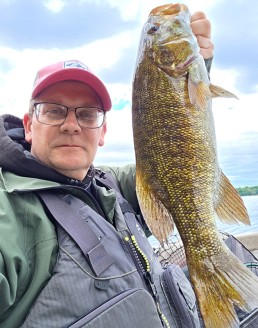
What has developed over the past 25 years or so is a legitimate smallmouth fishery, plus some largemouth bass I never saw back in my heydays. Numbers and sizes of smallmouths are good these days, and although I may not call it a “destination” spot for smallies yet, if you find yourself staying on the Chain and you are a smallie junkie like me, you won’t be disappointed.
Eagle River smallmouths love rocky, hard-bottom areas. No kidding, right? But here on the Eagle River Chain, those areas aren’t common. So, when you find these spots, they are golden. My strategy is a milk run of hard-bottom areas; just focus on them.
On-the-water boathouses are unique features on the Chain. They aren’t allowed to be built anymore, but what once was there, remains there, and they are fish magnets. Be respectful of private property, but pitch and skip every nook and cranny that you can. These boathouses hold bass, and even a muskie now and then.
 Eagle River Chain smallies love 3-inch or smaller craw baits, 2.8- to 3-inch paddletails, 2.75-inch tubes, 4-inch wacky worms, Ned rigs, drop-shots and 4-inch worms, and perch-colored jerkbaits. Most of the Chain is shallow (under 15 feet), so a lot of deep jigging or deep drop-shotting is not needed.
Muskies on the Chain have always leaned towards smaller lures. At one time, I think it was because the muskie population was smaller, but I think it was mostly because of a smaller forage base. At one time in my life, I was in the muskie lure business and had a booth at one of the Muskie Expos for a couple years. I had done a lot of articles on the Eagle River Chain, so I had a lot of people stop and ask muskie questions.
One gentleman had a house on the Chain, but after 5 years, he still hadn’t caught a muskie. We talked, and I asked about the lures he was using. He mentioned a Suick. I asked what size Suick, and he said 9- or 10-inch. I told him, just change to the 7-inch; trust me. He came back to the booth the next year and had pictures of at least 10 or 12 muskies he got the previous year, just by changing the size of his lure.
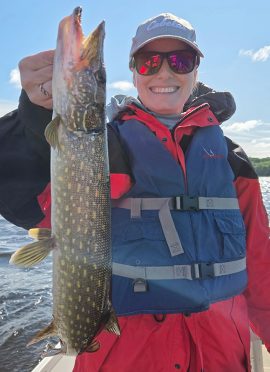
Eagle River muskie lures in my arsenal include the 7-inch Suick, 6-inch Grandma bait, the Cisco Topper, the Mepps Musky Killer, and normal-sized, muskie “rubber baits”—not “Pounder-sized” behemoths.
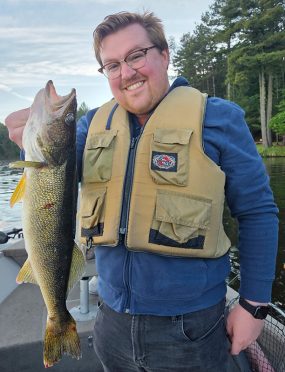
Walleyes are caught all over the Chain. There are a few big ones, but the main population is 14 to 22 inches. You can only keep one under 14 inches and one over 18 inches right now, but the regulations change all the time. Jig and minnow, Lindy rigging, and slip bobbers and leeches all work. I prefer 2.8- to 3-inch paddle tails, and mid-range crankbaits like Rapala DT- 6s or Storm Deep Jr. ThunderSticks. Walleyes like weed edges in 8 to 10 feet of water, hard-bottom areas, and old, main riverbed edges. Night fishing is great, but walleyes can be caught mid-day on the Chain.
Perch and crappies love shallow weeds. Keep things simple. Crappie minnows, a single gold hook, and a split shot are all you need.
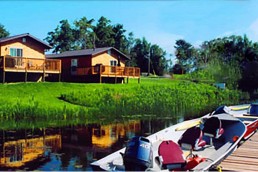
Unfortunately, VRBO rentals have replaced resorts, some of the cabbage beds are now milfoil, and 14-foot aluminum boats have been replaced with 24-foot pontoons sporting 250 hp engines. But there is still a wonderful charm on the Chain. Early mornings and evenings are still the classic Northwoods peace with loons, eagles and deer taking a morning drink. It’s still a great fishery for muskies and walleyes, with a strong, growing smallmouth population.
Yes, it’s changed over my 60 years of fishing there, but it’s still a great piece of water to spend a week and catch a variety of fish. I’ll be back again next year! See you on the Chain!
Did you enjoy this post?
You can be among the first to get the latest info on where to go, what to use and how to use it!