
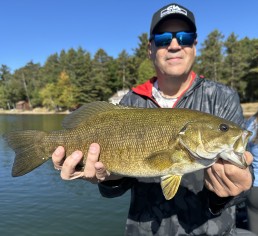
September Hot Spots for Natural-Lake Smallmouths
Another Labor Day Weekend passes, and the best time of year begins. Year-39 for me.
Smoke on the water, followed by sunrise at 6:30 am. The air’s crisp and cold in the upper 40s, and we’re now officially entering Simms outerwear season.
Squirrels are binge gathering, while smallmouth anglers and trophy hunters like us go binge fishing at every opportune moment. They head to big-fish destinations where beautiful northern, inland lake landscapes and porker smallmouths captivate our dreams, minds and motivation.
My wife wonders how we can continue to stay so excited about fishing when the last 10 years of my life and guiding career has turned so predictable, ritualistic, and repetitive.
When seasonal fishing and its processes become predictable and repetitive like it has, to the point of becoming boring, but always reinforced and saved when 5-pounders visit the boat daily, it defines a successful September fishing program.
I’m obsessed, and it never gets old.
One of the best lessons I’ve ever learned as an angler is to never commit to the lake(s) or destination(s) until the morning of—which is conservative; or as you hit the road to pick up the day’s customers—which is wisest.
“Where we headed to today, Andrew?” is the theme of our morning commute.
The anglers meet me at the pickup site located 3 miles away on the day. Being located along the 51/70 west corridor of Minocqua is a fortunate blessing. I have smallmouth destinations located north, south, east, and west. Some close by, many others far away, requiring an hour-long commute to get to.
Some of my repeat anglers know exactly where we’ll go, while most others are just along for the ride, adventure, and experiencing new things and places.
“This lake’s got this, that, some more of that, and what we need for the conditions today.”
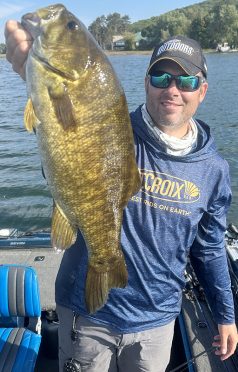 Early fall at smallmouth fisheries
Signs of fall are now happening everywhere, from diminished water clarity and decaying weed growth, to more schooling, heavier feeding, overall daytime activity, cooling water temperatures, and most fish species revisiting the lake’s littoral zone.
Water temperatures that were in the upper 70s a few weeks ago have now cooled into the upper 60s. With shortening daylight and colder nights, the entire food chain reacts, quickly acclimating to these changes. Prey species that were there a week ago have left. Those spots are now empty of fish.
The gradual process of turnover also triggers these movements, where much of the lake’s biomass revisits the shallows for optimal feeding conditions and homing locations, until turnover’s completion in October disperses them to anywhere in the lake—or they wisely flee toward wintering sites.
Early-fall lake locations are greatly influenced by forage movements and locations. But in all cases, smallmouths go where the food goes.
September is a high-forage-activity month, and many bass anglers repeatedly fail to realize that shallow water migrations of baitfish and forage species are taking place. Pay attention to your sonar and side imaging. See clouds beneath the boat and within casting range? Those will be yellow perch. Have yellow perch chasing baits back to boatside on every cast? Smallmouths will be in the vicinity.
Every lake fishes differently, and responds best tto specific strategy and presentation, but their personalities and characteristics can be alike, seasonally. Everywhere I’ll go this month contains expansive flats, beaches, and weed lines. The lake will have these primary ingredients (required), plus more that’ll also attract and collect smallmouths.
Another common theme happening at these fisheries is the perch pattern. Smallmouths residing in these lakes feast.
You can identify a classic September smallmouth lake fitting the criteria even before hitting the water.
Picking lakes to fish
You can explore a lake’s potential from your desktop computer or mobile device. Off the water, I closely browse through Google Maps on my desktop, pad, or phone to look at the lake’s overhead layouts and terrains. If I can pick out flats, weed beds, beaches, shorelines, lake terrains, and unique features on a satellite map, that’s one to fish. Then, when I’m on the water, I run a combination of Navionics and C-Map Reveal. Both charts display structure and contour lines in detail—aided by shaded relief, custom shading functions, and Genesis Social Maps (a crowd-sourced, high-definition customized map). I like using both programs with my Lowrance HDS Live and Pro units, as on some lakes, one chart could display better, and in greater detail, over the other—and vice versa.
Time is every angler’s number one asset. Without it, and the experience achieved, we wouldn’t know where to start and go, and have the September system. I’ve been doing this for a long time, and I’m still discovering new September fisheries.
Where we go on your trip, the day comes with a list of requirements and specifications. Besides needing to contain a historic and present-day trophy fishery, it also needs to contain these specific hot spots.
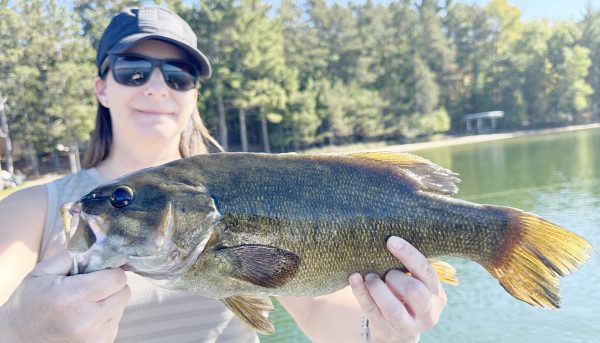 Flats
Flats
Identifying flats that provide smallmouths with a depth change, and immediate access into the lake’s main basin, should be the start of any September smallmouth hunt, no matter where you go. Smallmouths use flats extensively for traveling and feeding, and are always mobile and never stationary atop of them.
A great, smallmouth-producing flat will have structure, vegetation, and nearby depth. The flats of my waters all have one thing in common: a firm, hard-bottom component. It can be a hard, flat bottom featuring scattered areas of rock and gravel—some of which can be rock piles and boulder fields surrounded by sand. Otherwise, most of the flat will be firm, golden sand, with also a moderate scattering of low-lying submergent vegetation; common to my waters is brown cabbage, pondweed, water celery, and coontail. A combination of these additional habitats dispersed across the flat, and its edges, is prone to attract a very diverse forage base to these locations.
Drifting is the most effective way to fish a flat. Aided by boat control—with frequent Spot-Locking and positioning—you can cast search baits or drag bottom baits efficiently. You must keep moving and cover water. Catch one fish, and expect many others alongside it. Find the first fish, and you’ll be camping for a while.
Flats can keep you occupied for hours. Often, flats are the focus for much of the trip, where 20- to 40-fish afternoons can become possible, mixed in with several 3-to-5-pound specimens. All while drifting through these areas for several hours and bomb casting paddletails with the long rods.
As the month progresses, these spots get better, day by day, until turnover.
Sand beaches
Beach bumming has been the boat’s theme in recent years. Some lakes have expansive, natural, sandy beach shorelines stretching for several hundred yards (and even miles), while others have localized beaches scattered throughout the lake. Smallmouths love to lay and sunbathe on them.
For the highest catch rates and reliability, I favor localized beaches over endless ones. However, if endless, spot-on spots such as wood cover, logs, rocks, bottom transitions, and weed patches function as smallmouth magnets. You just gotta find them.
If they’re not sunbathing, smallmouths hunt on these beaches. Often, they’re cruising in pods. These fish are easily identifiable on side imaging, the most important fish-locating tool on my boat this month.
The emergence of shallow sand patterns is driven by the shortening of day length and less impactful sunlight radiance. Just like the work it does for smallmouths in early spring, sand in autumn also absorbs heat, functioning as a heat conductor and warming site.
Sand substrates continue to be a major fish attractor on northern lakes for their solar heat absorption. Locating sand is timely and easily done by browsing satellite imagery of your favorite lakes on Google aerial maps. Most lakes throughout Wisconsin, Minnesota, and northern Michigan are displayed in high-definition detail, and their very clear waters visibly show sand shorelines and underwater terrain.
Locating sand shorelines by boat is also time consuming. Visually, the best indicator of it is natural sand shorelines and beaches, and reeds. Troughs, and slight depth differences of as little as 1 to 2 feet, are just enough to be bass magnets in the shallows. These are scour holes formed by several years of ice forces and drifts. Smallmouths love to lay in them.
You can be among the first to get the latest info on where to go, what to use and how to use it!
Smallmouths often lie along bottom and wait to torpedo themselves into passer-by schools of perch. With their incognito, sandy-bronze color schemes that camouflage into bottom substrate, they are specialized, sand-bottom feeders.
 Weed lines with coontail
On fertile fisheries, many flats also contain plant life growing atop the flat and along the edges. In most cases, they can be isolated weed beds, or deeper weed lines. In other instances, the entire flat could sprout into a massive weed bar, too.
Coontail bars are the best, and typically grow along the flat’s edges in thick isolated clumps. It contains great cover to host prey fish and smallmouths, which are already drawn to these areas by August.
Coontail is known for its ability to disperse along lake bottom to depths of 15 feet or more. Across these lakes, September smallmouth locations are driven by the location of coontail, where they’ll use its edges and openings for ambush feeding. It also provides cover and protection during cold fronts, while also attracting young-of-the-year yellow perch and a variety of other prey and minnow species. In some lakes with reduced visibility, it grows shallower than you think.
Locate coontail bars with good side imaging such as Lowrance’s Active Imaging with its 3-in-1 transducer.
Broadleaf cabbage and green cabbage can be good too, but it decays, unlike coontail.
Weed patterns like this are dependable all month long, with the edges frequently attracting the largest smallmouths in the lake. These fish are less targeted and seldom found, compared to the structure-holding fish most smallmouth anglers pursue. We’ve captured noteworthy, 6-pound-class fish from the edges of these weed bars in recent seasons, with the most notable specimens falling for an assortment of swimbaits, yellow-perch-patterned swim jigs, and paddletails. The first time I caught a 6-pounder from the weeds, there was a potential 8-pounder swimming with it. We caught the smaller one!
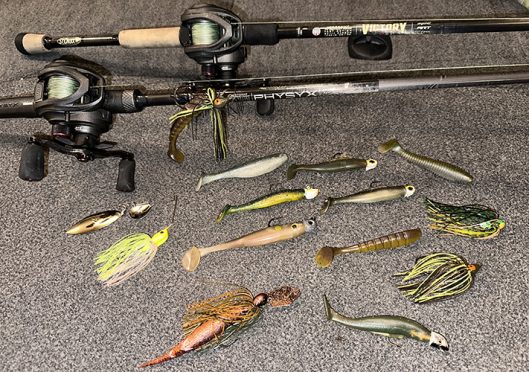
Weed patterns like this can dominate in September. The only kicker to it is that the food must be around and active. When it is, lure choices are easy. Perch-pattern swimmers and search lures encompassing swimbaits, paddletails, swim jigs and paddletail combos, spinnerbaits, and suspending jerk baits are all fished successfully.
Weed line fishing is a safe bet, too, on windy days, and in cold fronts, where smallmouths have protection from the elements. You’ll also catch muskies, pike and walleyes in these same locations.
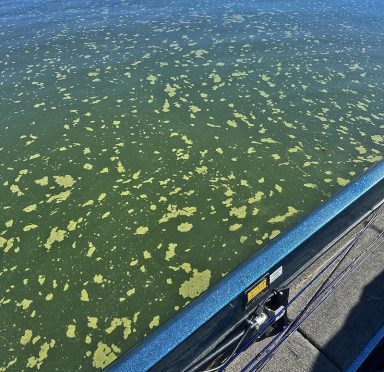 Algae blooms
Have no fear—the lake is not turning over just yet.
Common to several lakes this time of year are bloom conditions and reduced water clarities. I once refrained from fishing these waters altogether, but once I discovered their benefits for shallow-water smallmouths and aggressive style fishing strategies, I no longer mind a good bloom or two.
Algae blooms aren’t specific hot spots, but rather common, annual occurrences at many of the smallmouth fisheries we visit this month. During the midday and daytime hours, fish use them as a source of overhead cover to aid in feeding as they encroach on unsuspecting prey. On calm days, smallmouths dwelling in bloom lakes won’t spook away from the boat, as they typically would on crystal clear waters.
Blooms throughout September vary in intensity from tiny green specks in the water to dense pea soup. Blooms intensify on windless, sunny days. Thankfully, a good wind will break them apart and help improve the visibility. Learn to take advantage of bloom conditions.
Isolated rock piles
Rock piles are textbook hot spots for producing large numbers of big smallmouths in fall, but they receive the most pressure. Smallmouths gravitating to them are non-resident fish that are only there for feeding.
The best rock piles to seek are isolated. Most community spots show up on a lake map, while lots more are unmarked which you’ll stumble into. Boulders, palm-size rock, and gravel atop bedrock are most common. Find these spots, and they’re smallmouth magnets. Meanwhile, some of the largest flats you’ll drift through may eventually transition into large rock fields instead of weeds. You need side imaging and 360 scanning tools to find and pick them apart.
The primary source of food here is crayfish. As they will be present in moderate numbers, banging craw pattern crankbaits, dragging tube jigs, and crawling football jigs with craw trailers are the boat’s top producers, unlike the casting and horizontal baits we work through the other areas.
Last season, dragging a 3/8-ounce Beast Coast Tungsten Compound OW Sniper Jig tipped with a Z-Man Turbo CrawZ caught several quality smallmouths from atop these structures. Often, when drifting through sand beach shorelines, we stumble into sand-to-rock and sand-to-gravel or hard bottom transitions. The jig bite becomes most dominant in these micro spots. Areas with a noticeable change in composition are just as productive as rock piles.
Not every lake will contain crayfish atop the rocks. Some fisheries have smelt and ciscoes, and despite roaming offshore, they make end-of-year appearances back in the shallows.
A few fall seasons ago, guide customer Jason Norris set the boat’s all-time, single-trip, big-fish total, capturing 11 smallmouths 19 inches or greater, achieving a 5-fish sack of more than 25 pounds—all in less than 2 hours. What he achieved was that densely fog early morning atop the Ranger’s front deck with a 3.8 Strike King Rage Swimmer (Ayu) hasn’t been replicated since. I haven’t seen a huge pod of large smallmouths like that anywhere since.
Nomadic perch schools
Find the bait, start casting, and good things will happen. If there’s no life around, keep moving. The presence of forage drives all smallmouth movements for feeding.
Follow the food.
Yellow perch migrations provide the season’s best feeding windows. Across several premier inland smallmouth fisheries that are also home to perch, young-of-the-year yellow perch are attracted to grass flats and the deeper edges of weed lines. In areas of high concentration, dozens of perch will often trail lures to boat side. Little do they realize that they are a major reason why big smallmouths are in these locations.
Dialing in these perch migrations will help produce the largest smallmouths in the lake.
Wherever you will be fishing this month, acknowledge that smallmouths are opportunistic feeders, and predators who can creatively use their surroundings and habitats to help them ambush prey. Whether atop flats or holding tight to its edges, smallmouths lay low and wait to torpedo themselves into passer-by schools of perch. With their incognito, sandy-bronze color schemes that camouflage into bottom substrate, they are specialized feeders atop these locations.
The perch pattern program involves nothing more than searching for food first, then fishing second.
Side-imaging is an important feature when pulling up to the area to identify bottom, focusing on additional habitats atop the flat, and confirming presence of perch schools that could be 80 to 120 feet away from the boat. Whenever drifting through depths as shallow as 5 feet or less, it’s difficult to see most young-of-year baitfish on side imaging unless schools are thick and heavy. But it is advantageous for seeing where the patches of grass, troughs, and other bottom-growing plant life is in proximity to the boat’s position. Those grass patches attract perch and are major casting targets. On the Lowrance Active Target 3-in-1 transducer, it’s possible to pick apart large, cruising smallmouths in detail.
Juvenile perch are the sole reason why September’s smallmouth program excels with paddletails and swimbaits offered by nearly every brand and manufacturer. Often, multiple, young-of-the-year perch will be the first to follow-in your baits. Once observed, spend some extra time circling around that vicinity with your search baits. Smallmouths won’t be too far behind. Strikes can happen at any moment.
The perch pattern exists on every productive smallmouth fishery that we visit in September. Between September and October 2024, our rotation of lakes consisted of only 10 fisheries. Despite each one’s different fishability and personality, they fished well for us largely due to the perch pattern.
 September hot spots
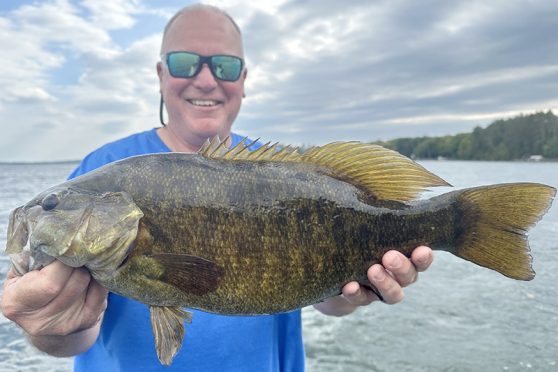
September is a top month for trophy fishing and spending your days exclusively on big-fish waters. If September has proven anything over the past 10 to 15 seasons, more big fish are caught now than any other time aboard my boat.
For the next 4 weeks, until turnover strikes, we’ll find ourselves drifting the shallows alongside the biggest smallmouths of the system.
September’s hot spots influence and force our hands on lake choices, strategies, travel itineraries, end-of-the-year urgency and fishing motivations. Everywhere we’ll go this month, I want every lake choice to contain combinations of these hot spots.
Food + Location + September = Trophy Smallmouth Bass


Did you enjoy this post?
You can be among the first to get the latest info on where to go, what to use and how to use it!