
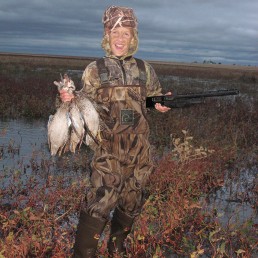
Midwestern ‘Early’ Birds
The hot, sweltering days of summer are almost over, and the promise of cool weather and hunting seasons are arriving. Some of the first birds moving south from northern nesting grounds are blue-winged teal, with a few green-wings mixed in. Heading south, teal begin showing up on potholes and wetlands in the mid-latitudes as early as late August. The first of many waterfowl to arrive, teal, along with doves, kick off fall hunting seasons.
These speedsters, so recently nesting, have raised their broods and are now making the return trip. In early September, the seasons open. Both dove and teal seasons open in early September, with some states now including an early wood duck season.
Scouting prior to the season is necessary to locate feeding and loafing locations. Locating shallow waters with abundant food, such as flooded smartweed and grasses, is ideal. Teal flock to these areas, sometimes in incredible numbers. Managed wetlands on State and Federal refuges and management areas are often loaded with ducks and hunters. Check ahead to locate birds, as well as access points, and hopefully areas away from the crowds.
My sons and I have routinely hunted teal in Kansas, Nebraska and South Dakota, participating in some spectacular, early-season hunts.
Hunting teal in early fall often takes place on warm days, before the first cold fronts begin to move through. Heat, humidity and mosquitos can be a problem. Snakes and ticks are still out. Often, a t-shirt, shorts, knee boots, and bug spray are all that’s required. Early teal seasons don’t always require waders, heavy jackets and gloves that late-season waterfowl hunts do, although Midwest days can quickly turn cool.
Finally, if teal are using an area for feeding, the hunting can be good late into the morning and early in the afternoon, not requiring such early-morning starts. Many of these issues make teal hunting a good introduction to duck hunting for youngsters. They get the experience of putting out decoys, calling birds, observing large groups of ducks, and getting close shots.
On a recent hunt in Nebraska, my sons and I located a U.S. Fish & Wildlife Service managed Waterfowl Production Area (WPA) with plenty of both water and teal. Many of the small ducks were out of sight in flooded smartweed and grass, visible when small groups got up and moved short distances to other feeding spots. Once we were out of the truck and quietly listening, we could hear lots of peeps and quick quacks around the edges of the open water, as well as deeper in the flooded vegetation. It was the second week of the season, and we were surprised that the birds did not seem to be disturbed.
Walking toward the wetland, we noticed some foot tracks and located a small blind and a dozen empty shell hulls littering the area. The teal that we jumped up only flew a short distance, landed, and resumed feeding.
We located a couple of other locations with water and birds on the same WPA, in case of competition the next day, a Friday. Both boys were out of school at noon on Fridays anyway, so I planned to give them the entire day off to hunt. That evening, we gathered up our gear and loaded the truck. The dog would be loaded the next morning.
You can be among the first to get the latest info on where to go, what to use and how to use it!
Arriving just at sunrise, we had the area to ourselves. Teal were already crisscrossing the area and landing in open water. We put on waders, grabbed shells, guns and water bottles, and headed in. I carried a sack of 18 decoys—mixed mallards and teal—as well as a motorized, spinning dove decoy. (The dove decoy seems to work great with teal, perhaps due to similar wingbeat speed. We have even had doves attempt to land on the decoy while it was spinning over the water.) We each had 20-gauge pump shotguns, which would be loaded with #6 steel shot once we were set up. We each also carried a “mud seat” to sit on.
Once the decoys and spinner were set up, we placed out mud seats in the 6- to 8-inch-deep water, crouched low behind some clumps of button bush and weeds, and waited. We set up with the wind at our backs, and the decoys set in small groups just on the edge of open water.
It didn’t take long for the ducks to arrive. Spotting the spinning dove decoy, they beelined in, focusing on the groups of decoys bobbing on the water. The shooting was challenging, with groups of 10 to 20 birds at a time coming in and attempting to land, with many flaring off in a variety of directions at the last moment.
At the shots from the boys, many of the birds, if missed, would climb straight up. That was my cue to shoot. Often waiting until the boys shot allowed me to relax enough and focus on a single bird as it climbed. Quite often, we all missed. Despite the quick and often erratic shooting, we knocked down birds, which our Lab quickly retrieved. Once again, an easy introduction to the season for her as well, with shallow water and close retrieves.
After a couple of hours, we had limits of teal, mostly blue-wings, with two green-wings mixed in. An exciting hunt, not too cold, and plenty of opportunities. On the walk out, we knocked down two doves and a snipe to add to the day’s bag.
Teal hunting opportunities abound during the month of September, with most blue-wings gone by October. Green-wings hang around much longer, even into January if open water and food is available. Although some states have opened early wood duck seasons, many don’t.
Take care to avoid shooting wood ducks that desire feeding in the same areas and often fly over at daybreak. In addition, northern shovelers or “spoonbills” sometimes fly with flocks of teal. They also have a blue shoulder patch, but are recognized by their larger body size and over-sized bill.
Read about more interesting fishing and hunting destinations in every issue of MidWest Outdoors. Subscribe on our website.
MWO
SHARE THIS POST
Did you enjoy this post?
You can be among the first to get the latest info on where to go, what to use and how to use it!
