
Decoy Strategies
“Listen!” I whispered to my son and friend. The distant sound behind us got louder until it sounded like jet airplanes were flying right over us. “Bluebills,” I whispered. The forty or so fast, plump diver ducks pulled a tight turn in front of us and headed back at us. “Coming right down the line!” exclaimed my son, Parker. “Get em!” I shouted as the big flock of bills dropped their feet and began splashing into the hole in our decoy spread. Nine rounds later from our Benelli’s and five plump bluebills were floating in the decoy spread as others banked and paddled away. “Which one of you shot a hen?” Parker asked with a smirk on his face that brought the same response from my friend and I, “Not me.” I started to drop the blind on the boat we were hunting from and said, “Let’s go pick them up before they drift too far. I think we have a lot more coming.” “It’s gonna be a great morning,” responded my friend.
I love waterfowl hunting. I was brought up on it as a kid with my dad and brother, as well as a few close friends. I am still just as passionate about it 45 years later, hunting with one of those close friends, still, as well as my son. My Dad’s health has him not hunting with us anymore, and another close friend and hunting partner passed away far too young a few years ago. That untimely passing only strengthened my passion for the sport, and the time spent and memories made with friends and family watching fall sunrises and listening for fall wings rushing through a cool NW wind. My favorite thing about duck and goose hunting? There are several parts of the sport that keep me getting up early and heading out onto the water or into the field. Ranking first would undoubtedly be the sight of ducks or geese with their wings cupped and their feet dropped on final approach to land in my decoy spread. That sight keeps me going during the long off-season between hunting seasons. Because this is my favorite sight while duck and goose hunting, I have worked over the years to develop and improve strategies for decoying ducks and geese. Following are a few tips that may help you be more successful while chasing waterfowl.
Realism
I try to improve my supply of duck and goose decoys each season. Companies are making more and more realistic decoys with better body and head positions, better paint schemes, and better wave riding ability. The first decoy spread I hunted over with my dad and brother consisted of a dozen mallard decoys—six drakes and six hens, eight bluebill decoys—four and four, and four pintail decoys—two of each sex. These were water keel decoys that needed to be set in the water upright so the hollow keel would fill with water to keep them upright. All of these decoys were the exact same posture with the exact same head positions. Jump ahead to today. We can get duck and goose decoys in sentry, swimming, resting, sleeping, upright sleeping, drinking, preening, and calling/greeting positions. Not only are the head positions different, but the body posture match those of a real duck in that position.
I use decoys from multiple companies to combine as many different body postures and head positions in my spread as possible. Hunting from a boat and often in big water, I need decoys with heavy keels that ride big waves well. Mixing and matching manufacturers helps me put out the most realistic looking spread I can. A shout out to the company I use the most, Dakota decoys. Their decoys are realistic, durable, and ride the water well.
I am a firm believer in flocked heads on goose decoys and mallard drake decoys. I think they simply fool ducks and geese better, especially wary late-season birds. Using these decoys, as well as fully flocked decoys available, means taking a little extra care to keep your decoys in good condition. I use individual pocket bags to protect flocking and paint on my decoys. This is some added expense, and these decoys require re-flocking from time to time, but I think it makes enough of a difference to justify the extra work and expense.
Vary your spread
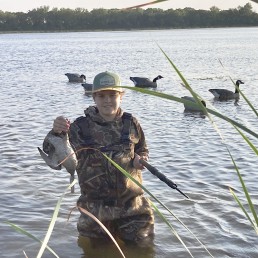
I try to not set out the same decoy spread twice in a season if at all possible. Ducks see a lot of decoys spreads on their trip south, and I want mine to be different than the others. In the opener to this article, we were hunting big water late in the season from a boat blind in a cattail island. We had out a long line of diver decoys leading into bunches of diver decoys and puddle duck decoys as well as some goose floaters with a large landing hole and some smaller one between the bunches. This spread was visible from long distances, was large enough to relax migrating birds, and allowed spaces for small groups as well as large flocks of birds to land.
Generally, early in the season I use smaller spreads with duck and goose floaters bunched in family groups of five to eight birds. When the weather is warm, I leave a lot of space between decoys. As the season progresses, I go to larger spreads with less space between decoys and forget the family arrangements. This is to account for larger migrating flocks with multiple families in them, and to mimic live waterfowl who sit closer together to conserve heat when the weather and water get colder.
I also try to match species of decoys to the species present or likely to migrate through where I am hunting. I always have multiple species out where I hunt in central MN, as we see a wide variety of species migrate through our area, so this type of spread looks realistic. For our early teal and early goose opener, I have goose, teal, and mallard floaters on the water. By late October, I have mallards, gadwalls, wigeon, pintails, canvasbacks, redheads, bluebills, and geese in my spread. By mid-November, the pintails, wigeon, cans, and redheads are gone, but more mallards, geese, and bluebills make up my spread with the addition of goldeneyes.
You can be among the first to get the latest info on where to go, what to use and how to use it!
Speaking of goose floaters, I almost always have some out. If we are hunting stale ducks that have been around a while, I will sometimes hunt a large spread of goose floaters only, or with a few mallards mixed in. Wary ducks seem to relax some when they see geese. Give it a try.
In addition to varying numbers and species of decoys, I also vary their arrangement. Don’t get hung up on the “C” or “J” or “fishhook” spreads that most people use a lot, and ducks and geese see a lot. In addition to these tried and tested spread formations, try two or three large masses of decoys with multiple landing holes, or multiple lines coming in to more birds, or scattered small bunches with multiple landing spots. I don’t always separate different species from one another, either, especially late in the season when mixed-species flocks of migrators are common. Mix it up!
Motion
Motion can be very important. I have several spinning wing decoys, both pole mount and floating. Early on I use one pole mount, later on I may have them all out. I tend to use them more often and more of them on sunny days, less on cloudy days. As the season wears on, I often turn them off when birds are on their final approach, and when they are running, I try to have one on constant and the other(s) on timer mode. Watch how the birds react and adjust to what they want. Do not hesitate to pull them altogether if the birds are not responding well to them.
On calm days, I use motorized decoys when hunting from a boat to get ripples on the water and movement in the decoys. It simply looks more realistic than dozens of decoys sitting on glass calm water not moving. I use battery-powered ripplers and swimmers hunting from a boat. Hunting from a shore blind, a jerk-string or two is an excellent idea on dead-calm days. Motion is often an after-thought for waterfowl hunters, but it often will be the difference maker and set your spread apart from others. Don’ neglect motion in your decoy spread.
If you like decoying ducks and geese in close and the thrill of the moment when you realize you fooled ‘em, I am right there with you. Go realistic with your decoys, mix up the numbers, species, and formations, and use motion wisely to get ‘em in close. Attention to detail will often make all the difference. Good luck, and I will see you out there somewhere.
If you enjoy waterfowl hunting, you’ll find suggestions for locations and techniques in articles found in MidWest Outdoors, available by subscribing on our website.
MWO
SHARE THIS POST
Did you enjoy this post?
You can be among the first to get the latest info on where to go, what to use and how to use it!