
Cranky Crappies
I have caught good crappies on big lakes, in rivers and in ponds. Usually, finding a mess of crappies is no big chore. I do have a “honey hole,” however. These six acres of water have never failed to produce a limit of 14-inch crappies for me. Nothing is a sure thing, but this pond is close.
I had been trying for a couple of years to make arrangements to bring my best friend Roger Lewis to this spot for a crappie catch, but we just had not gotten there yet. I had been able to take another fishin’ buddy, Kevin Brunstein, for a day with the big slab-sides. I even took my dad, Glen Roux, up there for a Father’s Day fishing trip. But Roger had not seen this place in person, and he was feeling a bit left out.
In June, Roger was going to come up to visit. I told him we would only be about 30 minutes from the crappie lake and that we should plan to go there.
I spent the 30-minute drive pumping Roger up about the crappies. I told him how big they were and how many of them we would catch. I told him of Dad’s 2 1/2-pounder and how we would not keep any under a foot long. I told him how he would get tired of catching them, but how good the fillets would be when they came off the grill. I really laid it on thick.
I have never had any trouble finding crappies on this water. There is plenty of standing timber, plenty of cover, and lots of aquatic vegetation. These are all essential components that black crappies require to thrive and reproduce. Unlike their pale cousins, white crappies, which prefer flat, mud bottoms, black crappies cling to structure and like weeds and weed beds. The darker variety also prefers cool, clear water. This small spring-fed lake is ideal for them.
Roger and I have differing philosophies when it comes to crappie baits. I will go with a Roadrunner wearing a Mister Twister Tail every time. I know they love it in this spot. Roger prefers a smoke grub. He has had tremendous luck in southeastern Missouri with this bait. So that is how we both started.
I drew first blood. A small bass, about a foot long, ate my Roadrunner. “I hoped that my first one would be a crappie,” I said to Roger. I then proceeded to catch three more bass that size in the next 10 minutes. No crappies. But I was in the fish and having fun.
Roger finally set the hook. The fish bent his ultra-light spinning rod almost double. When Rog lifted the fish into the boat, I saw that it was not a crappie either, but rather a huge, green-eared sunfish. “It’s over 10 inches long!” Roger exclaimed. That fish and many more, just like it and even bigger, went into the livewell. Still no crappies.
We fished for an hour with no crappie bite. We caught lots of small bass and big sunfish, but no crappies. It was time to try something different. I remembered how I had gotten the crappies at Mark Twain Lake to hit a miniature crankbait the year before. I had no idea if that tactic would work on smaller water, so I decided to find out.
I knotted a shiny, shad-colored, mini “Rat-L-Trap” to my line. This shrunken version of America’s #1 bass crankbait had paid-off big last year on the big water and the white crappies of Lake Springfield. I hoped for similar results today on small-water, black crappies. I guessed right.
A half-dozen casts into my experiment, I hit pay dirt. As the fish ran, the first thought that crossed my mind was that it was another bass. As I fought the fish on my ultra-light tackle, nothing changed my mind. Roger asked what I thought I had. I said it felt like a bass. Maybe a little bigger than the others. When the fish broke the surface, I was shocked.
You can be among the first to get the latest info on where to go, what to use and how to use it!
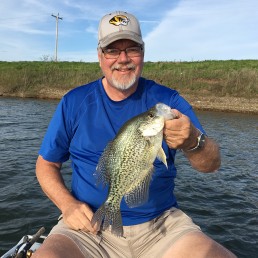
The silvery sides and black scale pattern of a black crappie are unmistakable. The markings on this fish were outstanding, and the fish had a mouth like a dixie cup. “How big is that thing?” Roger asked as the fish fought close to the boat. “Big enough to keep,” I replied. The fish was boated. She was about 15 inches long and weighed almost 2 1/2 pounds. “That’s the biggest crappie I’ve ever seen caught,” Roger sighed as he moved forward to examine the prize.
I thought he was coming to my end of the boat to praise my big crappie and me. All he wanted to see was the “Mini-Trap.” “Crappie on a crankbait,” he said. I would have never thought to try that.” I do not think he was totally convinced by this one fish because he continued to cast his grub.
Crankbaits have been fish catchers for quite some time. Only lately, however, have smaller versions of these baits been made available for panfish. The “Bill Lewis Lure Co.,” makers of the famous “Rat-L-Trap” crankbaits, leads the industry in manufacturing smaller crankbaits. The design of these lures is what I think stands them above the others.
If we look at why fish eat crankbaits, we soon discover that these lures imitate baitfish in several different ways. First, let’s look at shape. Now, I know that a lot of anglers like those big, round-looking, fat crankbaits. I also know they have some measure of occasional success on crappies. But for me, it must be a thin, flat crankbait. When I examine the prey of bass and crappies, they are thin, not fat.
The protruding plastic lips on most crankbaits turn me off, too. I have never seen a shad or a minnow with a plastic spoon in its mouth. Even though the clear plastic lips are virtually invisible on a moving bait in the water, action is sacrificed when you tie your line to a lip.
I prefer the lipless design made famous by Bill Lewis Lures. These baits are flat, lipless and come in enough different colors and sizes to satisfy every fish and fisherman. Not only is the selection wide, but the results are excellent.
Now, let’s look quickly at action. I like a crankbait with a very tight wiggle and a very loud rattle. The “Mini-Traps” that I now throw at crappies respond well to both criteria. I think that the tight wiggle of this thin, little crankbait more closely imitates natural prey than any other fast-moving lure on the market. I know the fish can pick up this high-frequency vibration and the rattling sound from quite some distance.
These crankbaits saved the day for Roger and me. We brought home all the fish he cared to fillet.
If you want to try a different, exciting fish species or technique, you’ll find plenty of suggestions in every issue of MidWest Outdoors. Subscribe on our website.
MWO
SHARE THIS POST
Did you enjoy this post?
You can be among the first to get the latest info on where to go, what to use and how to use it!