
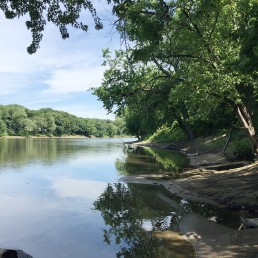
Flowing Water: A Refuge from the Summer Heat
The glow of the sun that we reveled in just a couple months back, now has us trying to hide and avoid it every time we take to the outdoors. The heat of late summer has locked in!
You can avoid some of the extreme heat and humidity portions of the day by being on the water at the very crack of dawn; spend the overnight hours on your favorite waters, if allowed; or head to what I’ve always considered somewhat of a daytime refuge from the heat: flowing-water systems. These often-tranquil fishing areas found along lazy rivers, and even a few large creek systems, provide tree-lined zones creating a bit of shade and relief from the overbearing and sizzling-hot sun.
Flowing water also offers more-oxygenated environments for the fish residing within these waters. Fish in small ponds and lakes struggle at times during prolonged heat extremes, losing oxygen; unrelenting heat can even cause summer kills. Weeds often overtake shallow ponds and small lakes, which is actually good for the fish that live below the canopy of weeds; but it’s a little frustrating for anglers trying to work presentations. In many public use areas, trees surrounding the shoreline have been cleared, or in the case of manmade waters, were never planted, keeping shade either non-existent or to a very minimum.
If you add the above considerations, and the fact that most river and creek systems contain practically all the species of fish that swim in the state, there is very little reason not to spend hot days along the banks of local flowing waters.
There are two ways of fishing flowing water systems, especially at this time of the year: 1) Probably the most intelligent approach, considering the extreme heat and humidity, is to find a nice section of river with a good thick shade canopy, and possibly a little deeper water within casting distance; put out some live bait offerings, either on the bottom or under a float, occasionally making a few casts with a basic lure or two—or 27. Pop open a few liquid refreshments from the cooler, kick back in a lawn chair, and enjoy a hot day in fishing paradise. Or 2) You can skip the relaxation and head out with me! I’m kidding a little; kicking back in the shade is often a much better option!
In all honesty, I’ve done both. But even with my hair changing to a lovely shade of silver, and sore bones, joints, and muscles, while still utilizing the shade for protection, I have to wander down the banks. I’m always wondering what is just a little beyond my last cast, sizzling heat or not!
Whether I choose a more stationary position or walk the banks, I’m searching for small pool areas off the main current; these usually have a little deeper water, and fish congregate in these areas. Big fish can lie in these pool areas out of the main current. I’ve caught everything from muskies and pike, to small- and largemouth bass, walleyes and sauger, crappies and bluegills, and of course a big cat or two. Some type fish are normally there. As for which species, well, that depends on the river system.
Another key feature is any type of object, whether manmade or natural, that offers a break in the current and has a little depth downstream; these will normally put you on fish. Rocks, logs and brush, sandbars are awesome places, as are manmade structures such as downstream from bridge abutments, concrete and wing walls, and downstream from dams. Large, shallow, riffle areas can hold a few fish, especially under darkness or very-low-light conditions. I prefer to focus on the outside edges of riffle areas near deeper water.
As far as gear, don’t overcomplicate your tackle, especially at this time of year.
Live, cut or natural bait
You can go as simple as ‘crawlers; they will draw interest from just about any species that call these rivers home. Minnows are great baits; the only issue under extreme heat conditions is keeping them alive. You can try aerated minnow buckets, but sometimes the heat is just too much; yet even dead minnows offered on bottom rigs or floats, or especially for tipping jigs, can be awesome as well. I often freeze leftover live minnows for future use, and honestly, they produce about as well as live ones; you just might have to add a bit of action. Frozen, uncooked shrimp works surprisingly well, as does cut bait or even chicken livers.
You can be among the first to get the latest info on where to go, what to use and how to use it!
The best presentation for live bait (for me, anyway) is a float rig. Fish the edges of the current and let the water’s flow carry your offering naturally along, or into deeper-water areas and pools. Cut baits and other natural baits on a bottom rig of your choice will create some action in these warmer waters. A lot of anglers swear by stink baits, especially for cats, but I prefer a more natural bait offering. If you like stink baits, they do work well on rivers, with current carrying smells downstream, attracting fish to your bait.
Artificial baits
I concentrate most of my river angling approaches on artificial baits, especially during the warm-water months. I carry much more in the way of tackle choices for lakes and larger bodies of water, whereas for river fishing, not so much; a handful of baits, carried in a small tackle box or bag, allow you to cover a multitude of species. The majority of my baits cover most of my local gamefish targets; if panfish are my choice for the day, I just minimize my bait sizes to match these river characters.
Three- to 4-inch swimbaits
These have become my go-to baits for most main-river occupants; they cover most species, down to bluegills and smaller crappies; I can still use swimbaits for them—just in the smaller, 1- and 2-inch sizes. These baits have basically replaced my need for carrying an abundance of tackle.
Hardbaits
Crankbaits have always been favorites of mine. I carry size 3 to 9 Original Rapala Floating Minnows to cover most species; as for colors, just try to stick with natural patterns, gold and silver. I’m a big fan of perch patterns, but just don’t care for fire-tiger as much, even on rivers. I know, I’m definitely in the minority there; some river anglers swear by fire-tiger, but that’s just my personal preference. Just for fun, try the gold Rapala minnow with the bright orange back; I’m not sure why that is, but it’s been highly successful for me. As always, please experiment.
Small spinnerbais
Beetle Spin type baits seem to be making a comeback, and these have been and are awesome on river waters. Tiny, small-pond-type spinnerbaits work well, too.
Jigs
Last, but in no way least, are jigs. I’m not sure what I can say about jigs that hasn’t been said or discussed over the years. You could probably leave every other presentation behind and just fish a jig, and you wouldn’t notice any change in your success. Jigs are just synonymous with rivers. Fish them with just a grub, or even plain with a minnow or worm, or better yet, a plastic grub tipped with live bait; it’s all you need for success on rivers, and not many baits could make that claim.
No specialty gear is required unless you target very large fish such as catfish, muskies, or pike. But for the most part, your standard gear will suffice.
I know the information was rather basic, but it’s the simplicity that makes flowing water angling even more enticing. Add to that, the shady banks of most rivers can offer a much-needed refuge from midsummer’s blazing heat.
For more insight and tips for fishing throughout the year, check out the articles in every issue of MidWest Outdoors, available by subscribing on our website.
MWO
SHARE THIS POST
Did you enjoy this post?
You can be among the first to get the latest info on where to go, what to use and how to use it!