
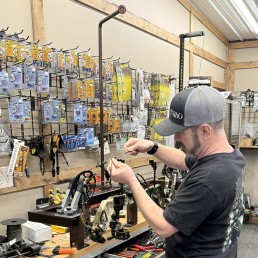
Summertime Means Bow Maintenance Time
The modern compound bow has become a precision “machine.” It’s part energy storage device, part timing device, and part surgical instrument. Even our accessories have become so technological they could be parts of a surgeon’s tool kit. All these advances have helped make us better shooters, we hope.
Thus, the need for regular maintenance is even more important today than in years past. Proper maintenance ensures consistent accuracy, quiet operation, and protects your investment. Now is the time to drag the bow out and give it a summer inspection and tune-up.
Every maintenance routine should begin with a simple visual and tactile inspection. After each shooting session, or at minimum of every few weeks, wipe down the bow with a soft cloth. Dust, grit, and dried mud can migrate into cam tracks, cable slides, and limb pockets, accelerating wear. If the cloth seems to hang up anywhere on the limbs, be sure to inspect even closer for cracks or delamination of the limb.
Inspect limbs closely under good light. Look for cracks, splintering, or stress lines, especially near limb pockets and cam axles where stress is highest. Modern limbs are extremely durable, but damage can occur from dry-fires, impacts, or improper storage.
Check the riser for hairline cracks around sight mounting holes, rest attachment points, and stabilizer bushings. Any structural damage here is a stop-shooting issue; have the bow inspected by a qualified pro shop before firing another arrow.
Strings and cables do more work than any other component on a compound bow. They carry load, transfer energy, and control cam timing. Neglect them, and accuracy and safety both suffer.
Apply bowstring wax lightly and frequently, every few shooting sessions for high-volume shooters, or at least monthly for casual archers. Focus on the main string and exposed cable sections, avoiding servings near cam tracks and release aid contact points. Rub the wax in with fingers until it warms and penetrates the fibers; excess buildup only attracts dirt. Look for fraying, broken strands, or fuzzing, especially near cam contact points and cable slides. Minor fuzzing is normal; broken strands are not.
Also inspect servings for separation or flattening, which can affect nock fit and timing. As a rule of thumb, replace strings and cables every 1 1/2 to 2 years, or sooner if you shoot heavily or notice creeping, peep rotation, or timing drift.
Modern cam systems, be they binary, hybrid, or single cam, are highly efficient, but require attention. Keep cam tracks clean and free of debris. Do not lubricate cam tracks or strings; modern bows are designed to run dry. Lubricants attract grit and can degrade string fibers.
Check axle screws for tightness and inspect cams for dings or burrs that could damage strings. Spin each cam slowly and watch for wobble, which may indicate bent axles or bearing issues; both warrant a pro shop visit.
You can be among the first to get the latest info on where to go, what to use and how to use it!
Timing and synchronization are critical. If your bow feels “off,” has increased vibration, or shows inconsistent arrow flight, timing may have drifted. While some archers use draw boards and presses at home, most shooters are best served having timing checked annually by a shop.
Limb pockets are high-stress interfaces that deserve regular inspection. Ensure limb bolts are evenly set and never backed out beyond manufacturer specifications; doing so can be dangerous.
Periodically check all fasteners on the bow: sight mounting screws, rest hardware, quiver brackets, stabilizers, and accessory mounts. Vibration will loosen screws over time. Use a torque wrench if available and apply thread locker where appropriate. A word on thread locker; Never use red. Red Loctite is so efficient that you may never get it to break loose. Blue Loctite is an archer’s best friend.
Accuracy depends on consistency, and consistency comes from secure accessories.
Inspect your arrow rest for worn launcher blades, bent arms, or frayed activation cords. Drop-away rests should cycle smoothly and return crisply. Replace worn cords proactively; they’re inexpensive insurance. Check sight pins for looseness, fiber-optic damage, and housing alignment. Even a slightly canted sight can throw groups at longer distances. Stabilizers should be snug and free of internal rattles. Excess noise often traces back to loose accessories rather than the bow itself.
How you store and transport your compound bow has a major impact on longevity. Store bows in a cool, dry place—never in a hot vehicle or damp garage. Heat degrades strings and adhesives; moisture promotes corrosion. Use a good-quality case during transport, especially if traveling. I recommend the bow cases from Lakewood Products for travel that does not include air travel, and SKB hard cases when you must fly to your hunting destination. If you use a case that has arrow holding inserts, do not store arrows with broadheads in the case! Every year, I see people walking into the bow shop with a bow that blew up inside the case due to a loose broadhead.
Even meticulous archers benefit from an annual professional inspection. A good pro shop can check cam timing, axle bearings, limb alignment, draw length accuracy, and overall tune. Preventive maintenance is far cheaper than failure.
The modern compound bow is remarkably reliable when maintained properly. Regular inspection, disciplined string care, attention to fasteners, and smart storage habits will keep your bow shooting quietly, accurately, and safely for years. Most maintenance takes only minutes, yet pays dividends every time you come to full draw.
Get better results from the time you spend hunting. Use information from the pros found in every issue of MidWest Outdoors, available by subscribing on our website.
MWO
SHARE THIS POST
Did you enjoy this post?
You can be among the first to get the latest info on where to go, what to use and how to use it!
