
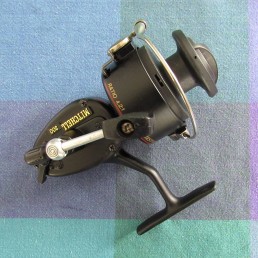
History of the Spinning Reel
The modern spinning reels that we use for fishing today are engineering marvels which are nearly flawless in functional design. Anglers take the modern spinning reel for granted, but before this spinning reel was introduced to the fishing fraternity, fishing was considerably more challenging.
In the past, our ancestorial anglers did not even use a fishing reel at all. Instead, the concept of fishing was quite basic, and a line was simply tied to the tip of a long rod. The rod was made from solid wood, bamboo or cane, and the line attached to this rod was about the same length of the rod.
Understandably, a short length of line severely limited the distance that an angler could present a bait to a fish; it also created a challenge for the angler to land the hooked fish with a limited amount of fishing line. A short line often required anglers to run along the length of the riverbank to chase after hooked fish. If the fish turned outward into deeper water, some desperate anglers would actually throw the rod into the water to create a drag/weight to exhaust the fleeing fish. While this technique sometimes worked, the next issue would be for the angler to wade into the water to retrieve the rod.
With the passing of time, anglers began to use longer lengths of fishing line instead of a short, fixed line that tied to the tip of the pole. This initial transition away from a fixed line was linked to a series of progressive changes that occurred in stages. The first change occurred during the early 1600s, when anglers began to use a tip loop secured to the top of the pole. The tip loop allowed a line to pass through the loop and permitted the use of a longer length of hand-fed line that could be used while fishing. Having a longer length of line was an advantage for reaching and then fighting a hooked fish. But this additional length of line was a troublesome burden, as the excess line lay upon the ground and readily tangled on a brushy shoreline or the angler’s feet.
It was evident that this excess length of line needed to be managed in some way. This needed advancement was implemented in the mid-1600s and early 1700s with the invention of the winder reel. This winder reel was based on the simple operation of a winch. When a handle was turned, the reel would wind the line around the reel. Winder reels were constructed from heavy brass, and their primary function was to store excess line. These winder reels were not designed for casting.
Starting in the late 1700s and progressing into the 1800s, the first practical fishing reel was devised by a number of different inventors in Nottingham, England. This reel would become known as the Nottingham fishing reel and was inspired by the wooden bobbins that were used to make lace in the industrial city. Nottingham fishing reels had a free-spinning spool which actually allowed anglers to perform casts. This ability to cast using a reel that both stored and supplied the line was a monumental leap in the sport of fishing.
However, there were inherent problems with the design of this Nottingham fishing reel. Nottingham fishing reels were manufactured from hardwoods such as walnut and rosewood, both of which created substantial weight to the reel. To compound the issue of the wood construction was what happened to the wood when it became wet. Constant exposure to damp conditions would make the wood warp and swell in size, creating jamming issues with the free-spinning spool, rendering the reel unusable.
Also, the free-spinning spool would often spin faster than the momentum of the line which was exiting the turning spool. This issue would introduce unfortunate anglers to dramatic backlash line tangles, which would infamously become known as bird’s nest tangles. The magnitude of some of these backlash line tangles would be so severe and unfixable, that it would effectively end the angler’s fishing day.
You can be among the first to get the latest info on where to go, what to use and how to use it!
As history has documented on numerous other occasions, many ideas are generated by existing inventions that are already being used for other purposes. This was the case with the concept of the modern spinning reel that is used extensively today. In the year 1905, fishing would be forever changed with the ingenuity of an English textile industrialist named Albert Holden Illingworth. Illingworth enjoyed fishing in his free time when he wasn’t overseeing operations at his textile factory.
Illingworth was disappointed with the functionality of the Nottingham fishing reel that was commonly being used at the time. While he was walking through his factory, Illingworth stopped to observe the weaving machinery that was winding a created strand of material upon a stationary line spoon. Watching this efficient line winding process, he knew right away that this same line winding method could be used on a fishing reel.
Illingworth began working on a new fishing reel that would be known as a spinning reel. Illingworth’s fishing reel design had a stationary line spool, and a rotating pickup bail mechanism that evenly wound the fishing line around this stationary spool.
The spinning reel design was rapidly embraced by anglers who were impressed by the functionality of the fishing reel. During the time period in which it was initially introduced to anglers, this spinning reel was so effective that it was initially banned from being used in British fishing competitions. The organizers and officers of the fishing competitions felt that it worked too well and was considered an unfair advantage.
In the following years, the initial design of the spinning reel would have other modifications—most notably with the fish-fighting drag system—and would evolve into the spinning reel that is effectively used by millions of anglers today.
Keep up with what’s happening in the sportfishing industry. Check out the articles in every issue of MidWest Outdoors. Subscribe on our website.
MWO
SHARE THIS POST
Did you enjoy this post?
You can be among the first to get the latest info on where to go, what to use and how to use it!