
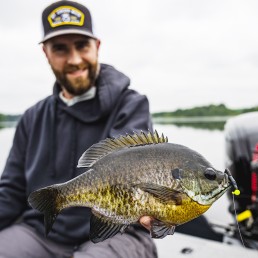
Ditching Live Bait: Confidence Matters
If you haven’t experienced the magic of your local bait shop, you’re surely missing out on some of the best fishing stories ever told. I can personally recall countless fishing-themed conversations I’ve been part of throughout the years. Many have centered around great days on the water, where fish were found, and most importantly, what they were caught on.
An all-too-common answer of mine? Plastics. Consequently, an answer, as such, often results in rather predictable reactions from two groups of anglers—the believer and the non-believer. The former has seen the power of artificial lures. They’ve caught fish on them, and they have a genuine understanding of how valuable the lures really are. The latter, on the other hand, may have purchased a few items, or maybe they know someone that uses them, but, ultimately, they haven’t given them a fair shot.
The truth of the matter—every application, technique, and situation is ruled by confidence—at least to an extent. Fishing with artificial lures is really no different. If the user has no confidence in what they’ve tied on, then the results are likely diminished. On the flip side, if confidence is part of the equation, then more positive results are likely to follow. In reality, it’s not much different than thinking negatively—as negative thoughts often result in negative outcomes.
Like every rule, there are exceptions, as certain colors, profiles, and types can excel in specific instances. Live bait still has its place, but there are countless applications in which plastics are more effective. For me, plastics, and other artificial baits, dominate 90 to 95 percent of my fishing time—no matter the time of year.
Artificial lures have long been popular in the bass market, but they’ve certainly taken longer to grab hold in other areas of the industry. That being said, they continue to grow in popularity—and for good reason, as they offer a number of advantages over live bait. Firstly, there’s no need to stop and buy bait—an entire step removed from the fishing process. Secondly, artificials don’t die. It sounds overly obvious, but this is rather advantageous on the water. There are no real concerns about temperature or aeration. Yet another benefit is re-baiting itself—or shall we say lack thereof. With many plastics, you can expect to catch several fish without replacing them.
Beyond the more obvious advantages, there are a handful of less-thought-about benefits that come with using artificial lures. Buying a scoop of minnows simply gets you a scoop of minnows. You don’t get any options with profile or color of the “bait” you’re using.
You can be among the first to get the latest info on where to go, what to use and how to use it!
Artificial lures come in a wide variety of options. Regardless of the scenario, there’s an option that’ll work. Take plastics for example. Realistic options are designed to imitate living creatures that exist in our waterways, like bloodworms, minnows, and other aquatic organisms. There are also more unrealistic options that aren’t really modeled after a living creature. Regardless of their specific shape or profile, the baits are designed to catch fish.
Aside from the wide range of profiles, artificial lures come in a variety of color options—including everything from natural options like browns, blacks, and greens, to more out-of-the-ordinary choices like pink, chartreuse, and wonderbread. The plethora of options gives anglers the versatility to match the hatch or use something a little more unique.
Artificials also provide anglers with a wider range of actions than their livelier cousins. A minnow, wax worm, or spike will simply act like a minnow, wax worm, or spike. Artificial options perform differently depending on the type of action an angler imparts. Take a gliding lure, for example. These lures can be fished in varying ways—which, in turn, provides different actions. A quick, ripping motion will cause the lure to dart and glide, while subtle jigging will cause the lure to hop more in place.
On your next fishing outing, leave the live bait at home. Grab that bag of plastics or hard bait you’ve been hearing so much about, and tie one on. Be determined to catch fish and have some faith in the bait you’re fishing with.
If you enjoy catfishing, you’ll find suggestions for locations and techniques in every issue of MidWest Outdoors, available by subscribing on our website.
MWO
SHARE THIS POST
Did you enjoy this post?
You can be among the first to get the latest info on where to go, what to use and how to use it!
