
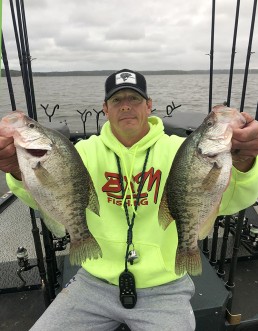
Stealth Mode for Crappies
Do you wonder why fishermen in other boats catch more crappies than you? It could be a better spot, bait or presentation. However, it’s likely that they are spooking fewer fish than you. When your dad said, “Be quiet, you’re spooking the fish,” he was right. A few tips and tactics can guarantee more bites, especially from big crappies.
Don’t create noise
Don’t create noise, including dropping objects in the boat, slamming a livewell lid, bumping baits against the boat, and talking too loudly.
“The shallower the water, the more important noise becomes,” says Clay Blair, tournament fisherman, part-time guide and pro staff for War Eagle Boats, B’n’M Poles and others. “Laughing and talking might spook fish in very shallow water, but I personally haven’t seen it to be a problem. But most noises become more critical in shallow water. Below 10 feet fish are not as spooky. If you do spook them in deeper water, they will come right back.
“Dropping items in the boat is bad. Also, something as small as how you place the jig in the water is important. If you present a jig and let it splash in the water, that fish may swim off. With a long pole, it’s important to ease the jig into the water so create as little noise as possible, or fish will know something is happening. I cast a lot to get the bait further away from the boat, and I cast past the fish, so the splash isn’t an issue.”
Control the boat
Control the boat because it’s critical to being stealthy. Fishing legends Ronnie Capps and Steve Coleman, eight-time national champions, have always preached that good boat control is the number one factor for successful fishing.
“Boat control is especially difficult when it’s windy,” says Capps. “Without boat control, it’s impossible to keep control of your bait. Can you keep control when you’re using the trolling motor in the wind, you kick your soda can over, and you’re trying to present a jig to cover? Everything is important, including doing all this without making too much noise, and while keeping the boat from getting too close to the fish.”
Fishing guide John Harrison says, “The number one thing for me is to never go over the top of the fish. It’s the kiss of death. The fish will spook, at least for a period. Another thing is to position the boat to have less wave slap. The noise of waves slapping the sides of a boat causes more spooked fish than most fishermen realize.
Harrison goes with the wind when possible because he has boat brakes. Going against the wind with an aluminum boat creates wind slap. If you can hear a little slap, you may not think it’s loud, but the fish can certainly know you are coming. Going with the wind helps.
Distance is your friend
Getting too close is an easy way to spook fish. It includes crappies in open water, on cover, shallow spawners, and other fish.
You can be among the first to get the latest info on where to go, what to use and how to use it!
“Too close is bad,” says Harrison. Crappies in cover might feel it’s safe compared to fish in open water, so they may be less spooky, but all fish are spooky to some degree.
“The distance at which a crappie spooks is different for different waters. On lakes with little fishing pressure, a fisherman might get as close as 10 or 12 feet without a problem. When fish have very heavy fishing pressure, like at Grenada Lake, Miss., the big fish may spook when you get closer than 25 feet. The first fish to leave a stump will be the big fish, every time. I’ve watched it repeatedly.”
Kentucky Lake expert and classic champ Tony Sheppard says, “I fish Kentucky Lake a lot and the water gets clear. When I approach a stake bed, I’ll start seeing fish leave out the back side of it. I might see 10 fish on it at 50 feet. At 30 feet, they start to sink down in the bed and some fish may leave. At 15 to 20 feet from them, there might be only three fish left in it. Weekend fishermen never see this with regular sonar. It’s important to know they do this, whether you’re seeing it on electronics or not.”
Trolling motor noise
Trolling motor noise has a big impact on fishing. New trolling motors are quieter, but they still make some noise. Fishermen are using them for every technique, including faster techniques like trolling. Also, some fishermen are going fast when looking for fish with forward-facing sonar, requiring a fisherman to ease up when seeing a fish. Bump the motor again and the crappies will swim off. Even moving a motor left or right will change how a fish hears it. Sound really carries in water. It’s common to catch smaller fish without a problem, but big fish pick up on it immediately.
More tips
More tips for being stealthy comes from Blair and Harrison. “Using LiveScope, I see a lot of fish go down to the bottom. You put a jig in front of a fish’s face and it goes down. The pressure on fish has blown up in the past few years, and crappies get chased a lot.
“Catch-and-release is a factor, too. More fish get caught and released because it’s more of a sport today than gathering food to eat, so fish learn and have become spookier.”
John Harrison agrees with Blair. “At some lakes, fishermen can keep any size fish they catch; but on other lakes, a crappie must be a certain length, so they have time to be caught-and-released a few times through their lives. They get more educated about fishermen. Like a big buck deer getting smarter as he gets older.”
The experts also agree that transducer noise is a problem. The noise is louder and stronger with the new forward-facing units. Experts are mixed on the amount of spookiness that transducer noise creates. The primary theory is to turn it off when you believe it could be spooking fish, especially in shallow water, or in situations when electronics aren’t necessary.
My final comment is to do everything possible to be stealthy. Don’t spook the crappies Put the odds in your favor and outsmart the big crappies on the water you fish.
Did you enjoy this post?
You can be among the first to get the latest info on where to go, what to use and how to use it!