
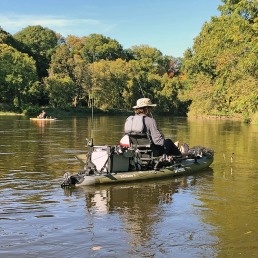
DIY Kayak Chain Anchor
Kayakers new to river fishing soon learn two important lessons: First, you don’t want your rods in vertical rod holders, as overhanging limbs can come out of nowhere and snatch ‘em. Second, a good river anchor can make your trip a whole lot more enjoyable and productive, not to mention safer.
River anchors are easy to make and not too expensive. Experienced river anglers prefer chain anchors, which are far less likely to snag, and they help you slow down without stopping when drifting with the current. But unaltered metal chain links create a lot of noise when dragged on the bottom. Since a lot of river angling takes place in close quarters, you’ll likely spook every fish within casting distance if you come clanging downstream.
Here’s how to make a stealthy one.
Start with five lengths of 1/4-inch chain, from 10 to 12 links (12 to 14 inches) long. A nice fellow at my local Home Depot cut mine to order, and I didn’t have to pay for the links he removed when cutting.
Now tie some fishing line on one end of each length of chain and dip each in Plasti Dip (or a similar product used to create handles for hammers and other tools) to coat it. Completely immerse the whole strand in the Plasti Dip can. Pull out to achieve an even coating on each length. The links will stick together, which makes the anchor quieter.
After letting most of the excess Plasti Dip drip back into the can, place the chain where the coating can dry. We propped four layers of cardboard in a cardboard box and steadied it with a barstool; 4-inch screws were easy to twist into the cardboard to hold each length apart from the others, and the cardboard leaned just enough so that the wet plastic coating didn’t touch it.
After the coating dries completely (at least 4 hours), snip the fishing line as close to the coating as possible, string the chain on a carabiner, and tie your anchor line to the narrow end. Some savvy river anglers prefer bright orange or chartreuse parachute cord for their anchor line so they can easily see it when fighting a fish.
“I use the chain anchor a lot as a brake, not to completely stop, but to move slowly down current with the anchor dragging,” says longtime Michigan kayak bass aficionado Jeremy Crowe. “The more line you let out, the slower you go until you actually anchor and stop. I usually let the anchor slow me down enough so that I can take 10 or 15 casts at a piece of structure, instead of just the two or three I could make going at the current’s speed.”
You can be among the first to get the latest info on where to go, what to use and how to use it!
Crowe, who showed me how to make my first chain anchor, notes that he needs five, 12-inch lengths of 1/4-inch chain to slow a big kayak, but fewer links if using a smaller boat. The carabiner makes it easy to add or subtract lengths of chain to customize it for a particular river’s current and the size of your kayak.
River anchors work best if you can lower them off the stern of your kayak so you face downstream when riding the current. I am a big fan of the Anchor Wizard system that has a hand crank you can install right next to your seat, and an anchor receiver you can bolt on close to the rear of your kayak. The hand crank has a clutch, which makes deploying the anchor a simple matter of turning the handle so the spool lets out line.
An alternative to a chain anchor is a dumbbell normally used for weight training. I cobbled together a dumbbell when I was on the way to a distant river and realized that I left my chain anchor in the garage. In the predawn hours, I stopped at an all-night Walmart and bought a 5-pound, plastic coated dumbbell and some heavy-duty zip ties. I took about three feet of rope, then tied a loop in the middle and overhand knots on each end. With eight zip ties total, I attached the rope at each end of the dumbbell handle. It worked surprisingly well for not only stopping my kayak when I let out enough line, but for slowing the kayak with the dumbbell bumping bottom.
A third option for kayakers is the Chene CH-10 anchor, a 2-pound, fluke-style anchor that costs $75 at www.cheneanchor.com. This has a sliding O-ring for anchor line attachment, which allows easy extraction from snags. It’s a good one for stopping your downstream drift, but doesn’t work at all for bumping bottom and slowing downstream progress.
One last note concerning anchoring in rivers is to have a knife or set of side cutters handy, just in case the anchor becomes hopelessly snagged. Few things are more frustrating than being stuck and having no way to cut yourself free.
This summer, escape the recreational boat traffic of our inland lakes and take your kayak down one of the Midwest’s smaller rivers. Along with peace and quiet, you’ll likely find some awesome fishing.
Get better results from the time you spend fishing. Use information from the pros found in every issue of MidWest Outdoors, available by subscribing on our website.
MWO
SHARE THIS POST
Did you enjoy this post?
You can be among the first to get the latest info on where to go, what to use and how to use it!