
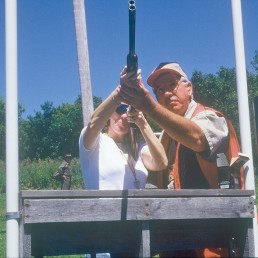
Improved Shooting Equals More Birds for the Table
Many older hunters probably learned their hunting and shooting skills from relatives. If you are like me, that meant you learned poor shooting skills. My father’s advice for shotgun shooting was “point it in the right direction and pull the trigger.”
By practicing on clay targets, hunters improve their success in the field. I do not mean just going to a trap or sporting clays range and shooting all the targets. Focus on those clays cast in a manner like what you will encounter in the field. Overhead, rising and crossing shots are best.
What are we looking at when a pheasant flushes? The answer is obvious, the tail to identify cock birds. That is also where we often shoot. When hunters miss, it’s usually because we’re shooting behind the bird.
The amount of time available for shooting is much more than most of us expect. To illustrate this point, take a shot at two clay targets cast right after one another. We usually hit one or the other but not both. Typically, we rush one of the shots thinking there is not enough time.
Place only one shell in the double barrel gun. Cast two birds, with the shooter shooting one, loading the second shell, and shooting at the second clay target. It is a dramatic way of demonstrating all the time that is available for aiming and shooting. You will improve significantly in the number of birds hit.
Getting back to the pheasant flushing, just where should a hunter be looking? With all this time available, he should look first to identify the bird as legal. Then look to the eyes of the bird. If you can see the eyes of a pheasant, you can kill it. The idea is if you can see the eyes, it is within range. Your focus is at the front of the bird, and you will not shoot behind it.
Another area to examine, is gun “fit.” The fit of a shotgun has more to do with how one holds it rather than cutting down, or building up, the stock. It is a question of how the hunter mounts the gun.
One way to practice proper mounting of a shotgun can be at home. The hand that holds the forearm of the shotgun should have the index finger pointing toward your aiming point. This allows the shooter to point to his target, making the shot a more natural function.
You can be among the first to get the latest info on where to go, what to use and how to use it!
The shooter can stand 5 to 6 feet from a mirror with a gun that is empty. He then mounts the gun to the shoulder and points toward the mirror. If the gun is properly mounted, the bead on the end of the barrel and the shooter’s eye are in alignment. By practicing this many times at home, it becomes a natural feeling mount when in the field.
What about the difference when shooting with heavy clothing as opposed to shooting with light clothing. To compensate for that, move the hand back or forward on the forearm of the gun. That is, still with the index finger pointing where you want to shoot.
Once in the field two other points are important. With clay targets, focus and shoot at the forward side of the target. This “head” side is the one that is toward the direction the target is moving. Do not focus on the bright color body of the target or on the “backside.”
The other point is to raise the barrel up to the target, not from above down. If bringing the barrel down from above the target or bird, you block your view of the bird.
Get out this year and try these new techniques in the field.
For more insight and tips on how to make the most of the time you spend hunting, check out the articles in every issue of MidWest Outdoors, available by subscribing on our website.
MWO
SHARE THIS POST
Did you enjoy this post?
You can be among the first to get the latest info on where to go, what to use and how to use it!