
The Ultimate ‘Walkabout’ Bait
While prepping my carrying tackle to head out to wander the banks as the summer sets in, the term “walkabout” settled into my head. Not wanting to sound foolish, I sent a text to an Australian friend and an outback kind of guy; he was actually born and raised in the Australian “outback,” so he gave me a little history on the “walkabout” concept and a full blessing to use the term.
Basically, an Indigenous Australian rite of passage, “walkabout” describes a journey into the wilderness, cut off from communication from the outside world. I’m thinking that we’d never survive today, with nowhere to plug in our phones.
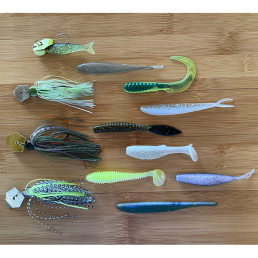
Over the last year or so, I was diligently trying to narrow down my bait selection for those especially long wanderings; down to not only minimal tackle, but going so far as to limit myself to just a single bait presentation, yet still experience optimal success on the water. With this “single bait goal in mind,” and countless testing hours spent afield, I believe that, at least, for my angling, I have found a bait that checks most of the boxes to what I was trying to accomplish while chasing bass—yet with a minimal amount of gear strapped to my back. While certainly no bait holds the title of being the “perfect bait,” I believe the choice for this column will get you in the neighborhood, close to perfection, at least for the wandering bass bank angler. The bait is… mini- and micro-sized bladed jigs.
Bladed jigs. You’ll hear most people referring to them as Chatterbaits, which is actually a brand name used by Z-Man Tackle, which pretty much put the bladed jig on the map and created such a huge following. Originally, my first thoughts were that the bladed jig would probably end up being somewhat of a “fad bait,” hot for a few seasons then, on to something else; but I was way off on this one for sure. Bladed jigs have been around for quite some time, and with the tournament wins and favor among most bass anglers, this bait is not going anywhere; it’s actually still growing in popularity, with many manufacturers adding different model bladed jigs to their lineups.
I’ll admit, I was a little less than enthusiastic when they first came out; I bought a few, caught some fish, but it just wasn’t a bait that I liked to throw back then. My sense of interest in the capabilities of the bladed jig has changed drastically since the bait made its debut. Now, I fish just about every style and weight/blade variation available.
While the bladed baits seem to share a somewhat standard appearance, by changing the offering used as a trailer, you can affect and change everything from a visual perspective to how much sound output you care to achieve, to sink rates and buoyancy.
So, with bladed jigs being nothing as far as a new concept, why the current interest? Primarily, while I’ve used bladed jigs in many fashions over the years, not until recently have I begun exploring my favorite waters while using the mini and micro versions. And what a wake-up call it has been! My “normal” bladed jigs have always been in that popular size range—3/8-, 1/2-, and 3/4-ounce—but I began to experiment with baits 1/4-ounce and less, and the numbers of fish I caught skyrocketed. Of course, with the downsized versions, you’ll naturally catch more smaller fish, but larger fish certainly don’t hesitate to crunch down on these bite-sized offerings.
Why the attraction toward these smaller baits? For a couple of reasons, in my opinion. One, I haven’t seen as many anglers throwing these mini versions of bladed jigs as much as they do the standard sizes. In heavily pressured waters, where I do most of my angling, I believe that bass can get a little conditioned to the sight and sound of these larger baits. The smaller versions have much less sound output and a less obnoxious, visible water disturbance. Bass, and most her other fish as well, become a little less wary about approaching these smaller offerings.
As far as size, since I fish primarily fish Z-Man Chatterbaits, and only Z-Man baits in the mini and micro sizes, 1/4- to 1/8-ounce baits get most of my work done. While they do make a 1/16-ounce version that is incredibly small, I’ll save these for very small bodies of water, like small ponds, creeks, and river arms; or for where the fishing pressure is insane, in heavily used public waters such as park district ponds.
When I approach a body of water rigged with the smaller-version bladed jig, I generally start off with the 1/8-ounce to get an overall feel of how the fish are responding to my bait. If they are pretty aggressive, I’ll bump my bait up to 1/4-ounce, because I can get more distance in my casts, therefore covering more water.
You can be among the first to get the latest info on where to go, what to use and how to use it!
You can’t talk about bladed jigs without discussing trailers. For my bladed jig trailers I lean toward plastics with subtler actions; even straight-tailed at times, as the jig in itself has an intense amount of movement and vibration. Using a wild trailer can put the bait over the top in my opinion, with almost too much action.
Finding trailers for these mini versions is not a problem. Just use smaller versions of the larger ones used for standard-sized bladed jigs. But don’t overwhelm yourself with trying to carry all types of trailers. Look either for some type of straight-tailed action, or a swimbait version if more tail action is needed; curly-tailed grubs are often forgotten about, but make excellent trailers. For small, mini-version baits, your tails will probably be in the 2- to 3-inch range to make the bait look more compact, which is the size you’re focusing on.
Use the same bait and trailer colors as with the standard sizes: Whites with colors added to the skirt, such as silver or greens, look very natural. Choose minnow and shad variations, and colors that match bluegills, the main diet of bass in smaller ponds and waters. Black and blue is a popular color, as are fire craw red colors and chartreuse. But silver and greens are my most consistent producers.
Using these baits, you can cover water from the surface down to the bottom depths; their only drawback is they don’t work well in very heavily weeded waters. You can work them through sparse cover and rip them out of the weeds. But bladed jigs are best suited for rather open water, above or on the edges of weed lines, or bumped off rocks or wood. Trial and error is always the best way to find active fish.
One little pointer on retrieves: If you can just chuck and wind these baits with a straight retrieve, you will catch plenty of bass. Better yet, during the retrieve, try pulling your bait a foot or so at a time, and let the bait sink a foot or so, then go back to your retrieve; these little, odd bursts often trigger a curious bass or two.
A standard light to medium-light, fast-action rod works for me; keep that rod sensitive enough to feel blade vibration. I use 8-pound braid for most of my casting of mini bladed jigs on spinning reels, but lately have found these to also be excellent on today’s BFS ultra-light baitcasters.
So, if you’re looking for a little adventure and somewhat of a “walkabout” experience with rod and reel in hand, give the mini versions of bladed jigs a try.
If you want to try a different, exciting fish species or technique, you’ll find plenty of suggestions in every issue of MidWest Outdoors. Subscribe on our website.
MWO
SHARE THIS POST
Did you enjoy this post?
You can be among the first to get the latest info on where to go, what to use and how to use it!