
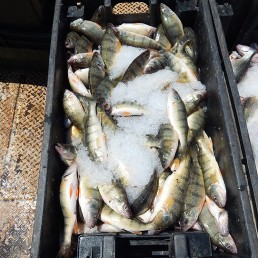
2026 Allowable Catch Limits Set for Lake Erie
By the end of the annual Great Lakes Fishery Commission’s Lake Erie Committee meetings in Ypsilanti, Mich. in March, each of the jurisdictions that border Lake Erie agreed to lower 2026 walleye and perch quotas.
Total Allowable Catch (TAC) quotas are not goals to catch, but the recommended maximum number of fish that may be safely harvested in the upcoming season without harming the populations.
What follows are a lot of numbers detailing the efforts that Lake Erie’s fisheries agencies perform to try to ensure that the populations of these two most economically important species continue to be sustained.
Walleye
From estimated highs of over 90 million “catchable” walleyes (aged 2 years and over) in 2023, the committee projected that a population of 57.6 million will be present at the start of this (2026) season.
Consequently, Lake Erie’s 2026 Western Basin/Central Basin walleye TAC was set at 10.171 million fish, down 10.6 percent from 2025.
Dividing the fish largely based on surface area, but also tweaked using other inputs such as favorable habitat area, Ohio is allowed 5.198 million, Ontario gets 4.380 million, and Michigan is allotted 593,000 walleyes.
In the Ontario portion of Lake Erie, most walleyes are commercially netted, and by doing so they can usually harvest the majority of their allotment. In fact, they exceeded their quota in 2024 by 389,008 walleyes.
Commercial walleye fishing in Ohio was halted in 1970 when high levels of mercury were determined to be present in the fish. This heavy metal contaminant has since diminished due to water pollution regulations enacted after passage of the Clean Water Act of 1972 and reductions in air emissions from burning coal.
The Ohio Administrative Code (OAC) specifies what the daily recreational bag limits for walleyes will be based upon the TAC level. When Ohio’s walleye TAC is greater than 3,000,000 fish, the daily recreational bag limit is six fish year-round.
Spawning success in the Western Basin has been good or excellent for many years, including eight of the past 11 years. The 2025 hatch, which will enter the fishery next summer, was measured as the sixth largest on record with well-above-average numbers also seen in Central Basin fall sampling trawls.
Yet, despite calls from some to raise daily limits while populations are high, the Ohio Division of Wildlife is electing to manage walleyes conservatively by keeping extras on hand as a cushion for years with poor recruitment.
Ohio’s recreational walleye harvests have hovered around the 2 million fish mark annually for the past several years, well below the TAC allotments, which has allowed many to grow to trophy sizes when harvested later.
Thanks in part to more people adopting trolling to catch walleyes in the Western Basin, catch rates were calculated using creel surveys to be 0.93/hour in 2025.
Daily bag limits for walleyes are six in each of these jurisdictional waters during the open season, which is year-round in Ohio, Ontario, and Michigan, but was closed from March 15-May 6 in Pennsylvania and from March 16-April 30 in New York.
Yellow perch
Yellow perch harvest in Lake Erie is regulated using four Management Units followed by the wildlife agencies in Ontario, Michigan, Ohio, Pennsylvania, and New York.
You can be among the first to get the latest info on where to go, what to use and how to use it!
Ohio shares MU 1 with Michigan and Ontario, MU 2 with Ontario, and MU 3 with Ontario and Pennsylvania. Ontario, while Pennsylvania and New York border MU 4.
The 2026 perch TAC dropped in all four MUs compared to 2025. Diminished plankton densities due to invasive Quagga mussels’ filtering of the lower food chain’s beneficial algae is more often being cited as the cause of poor recruitment of larval perch into the fishery in all but MU 1.
In MU 1, essentially the Western Basin of the lake, a TAC of 1.831 million pounds (-20 percent from 2025) was prescribed for harvest this season. Ohio is allowed 921,000 pounds, Ontario is granted 743,000 pounds, and Michigan is sanctioned for 167,000 pounds.
For yellow perch, which is a permitted commercial species in Ohio, the Ohio Administrative Code also spells out what the ratio of recreational vs. commercial harvest quotas will be in each management unit, based on the TAC.
When the MU 1 TAC is over 800,000 pounds, the yellow perch catch quota split is to remain at a 65 percent sport and 35 percent commercial take. The recreational angler daily limit shall remain at 30.
Anglers often struggle to entice perch to bite their shiners used as bait, as studies have shown a diet shift to invertebrates including mayflies, midge larvae, aquatic worms, and a high reliance on feeding on invasive Spiny water fleas, whose densities have expanded exponentially in the Western Basin.
In MU 2, running roughly from Huron to Fairport Harbor in Ohio and along the Ontario shoreline from about Wheatly to Rodney, Ontario gets 355,000 lbs. and Ohio is allowed to harvest up to 423,000 pounds of the 778,000 pounds total (-20 percent from 2025).
With Ohio’s TAC falling under 800,000 pounds in MU 2, this specifies that a 75 percent sport and 25 percent commercial harvest be followed here, where the daily sportfishing limit remains at 10.
In MU 3, which extends from Fairport Harbor, Ohio to a bit east of Erie, Penn., Ohio receives 413,000 pounds, Ontario is permitted 666,000 pounds, and Pennsylvania gets 195,000 pounds of the 1.274-million-pound total (-40 percent from 2025).
Since Ohio’s TAC in MU 3 is between 400,000 and 799,999 pounds, sport fishermen will be allotted 70 percent and the commercial fishery 30 percent with the daily sport fishing limit unchanged at 20.
In MU 4, Pennsylvania gets 53,000 pounds, New York is slated for 149,000 pounds, and Ontario was allotted 280,000 pounds of the 482,000-pound total.
On Lake Erie, the daily recreational limits for yellow perch are 50 in Ontario, New York and Michigan, 30 for Pennsylvania, and from 10 to 30 in Ohio waters, varying among management units as explained above.
Keep up with what’s happening in the sportfishing industry. Check out the articles in every issue of MidWest Outdoors. Subscribe on our website.
MWO
SHARE THIS POST
Did you enjoy this post?
You can be among the first to get the latest info on where to go, what to use and how to use it!