
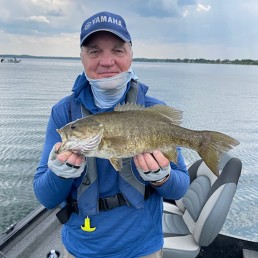
Smallies on Mille Lacs
Mille Lacs is a big lake—the second largest natural lake in Minnesota. Look across the lake to the other shore, and it disappears into in a hazy horizon.
It is loaded with fish. It has been known for decades as one of Minnesota’s premier walleye lakes. Some of the biggest muskies caught in the last 20 years have come from its waters. Today, it is also known for its big smallmouth bass.
Smallmouth bass brought four of us to Mille Lacs in early summer. Our group consisted of Doug Hurd of Inver Groves Heights, Minn.; his brother Dan Hurd of Waunakee, Wis.; his nephew Jim Rehorst of Kent, Wash.; and me.
Our first morning featured clear blue skies and light winds, as we left our resort and headed out onto the lake. The sun skimmed across the water. Although cool to start, it was only a matter of time before the heat came over us.
Find rocks, and you generally find smallies. We were in two boats and came to a stop off a rocky point. We put suckers on our hooks and started drifting live bait rigs with the wind.
We drifted along, correcting our course with the trolling motor in about 3 to 10 feet of water. The water was so clear that we could see the rocks on the bottom.
“I think I have a fish here,” Doug said. He waited a few moments and reared back to set the hook. His casting rod bent in half, rod tip plunging as the fish surged off. “This is a good fish,” Doug said.
I quickly pulled in my casting rod, dropping it on the floor of the boat, and reached for the net. Doug turned the fish, and it rose in the shallow water, swirling on the surface before diving again.
There is no quit in smallmouth bass, and this fish kept pulling back each time Doug started getting it close to the boat—a chunky, brown shadow in the water. Finally, he got it close enough that I was able to pull a net up under it, hauling it into the boat. The fish never gave up, even in the net, twisting and turning as Doug reached in and pulled it out. We quickly measured it before releasing it; it stretched to 16 inches, and was a nice start to the day.
Second in size only to Red Lake in northern Minnesota, Mille Lacs covers 132,516 acres. It has a maximum depth of 42 feet with most of the lake ranging from 20 to 30 feet in depth.
Gravel and rock bars are found throughout the lake. These are ideal spots for the famed walleyes, and now smallmouth bass.
The lake, 75 miles from Minnesota’s Twin Cities, is one of the most popular fishing destinations in the state. It has been known for decades as a great walleye fishery.
During winter, it is known for its yellow perch fishing. For a generation, it has become the home of some of the best muskie fishing in the state, accounting for several state records.
You can be among the first to get the latest info on where to go, what to use and how to use it!
And then there is smallmouth bass. Over the last 20 years, smallmouth bass fishing on Mille Lacs has received national acclaim. For several years, a national bass magazine named Mille Lacs as the top bass fishing destination in the country. Today, smallmouth bass fishing there hosts not only lots of fish, but lots of big fish as well, and in many ways has overshadowed the lake’s famed walleye fishing.
Any number of baits work on smallmouth bass, but one of the most productive on Mille Lacs is dragging bait rigs. It starts with a 4-foot leader. Doug uses fluorocarbon line for his leaders. Zebra mussels inhabit the lake, which has made water clarity much greater, so the fluorocarbon is a good idea. The leader is attached to a swivel; above the swivel are several colored beads and a 1/8-ounce slip sinker. Since we are fishing in 4 to 10 feet of water, Doug tells me that anything heavier hangs up too much in the rocks. On the other end of the leader is a 1/0 circle hook. For bait, we use 3- and 4-inch suckers. We fish these rigs with 6 1/2- to 7-foot casting rods.
With the wind and trolling motor, we drift over rocky areas. When a fish hits, we press the release button on the reel, count to ten and then set the hook. The fight is immediately on.
It is now late afternoon. I feel a fish hit my bait, and I hit the reel release as line is running out. After counting to ten, I set the hook and pull back. I feel the thumping of a fish, and then it tears off. The drag on the reel is giving out line and the casting rod is doubled over.
I stop the fish and get it turned around, but only for an instant before it takes off again. The fish hugs the bottom, pulling against the casting rod. The fish stops running and I start getting it coming back toward the boat, but the fish doesn’t give in. I just hold on until it stops, and then pull back. The fish is now running sideways, line slicing through the water.
It is getting closer, and then we see it in the clear water. It is a huge, brown shape pulling away again. After a couple more short runs, I get it near the boat, but each time Doug extends the net, the fish pulls back. Finally, Doug pulls up on the net and the fish clears the water, thrashing, spraying water.
We measure the fish. It is a 19-inch smallmouth. After a couple quick photos, the fish went back into the water. It was our last fish of the day.
Twenty minutes later, the wind picked up, and dark clouds were piling up to the west. A storm was on the way. On big, shallow lakes like Mille Lacs, storms can blow up suddenly.
It had been a good day. Mille Lacs lived up to its reputation as a great smallmouth bass lake.
Author’s note: This story is dedicated to the memory of Jim Rehorst. He passed away suddenly and unexpectedly in January 2026, six months after we fished with him on Mille Lacs. He was 56 years old. He leaves behind his mother Barbara, and three young children, Donovan age 8, Talia age 6 and Poppy age 4. Jim is greatly missed. A son, father, nephew and fishing buddy. Rest in peace.
Thinking of trying a new fishing destination this year? You’ll find plenty of suggestions in every issue of MidWest Outdoors, available by subscribing on our website.
MWO
SHARE THIS POST
Did you enjoy this post?
You can be among the first to get the latest info on where to go, what to use and how to use it!