
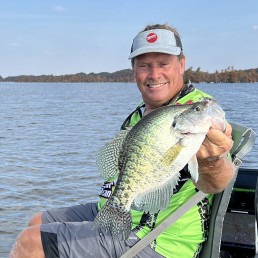
Reelfoot Lake Crappies and More
Generations of fishermen have used Reelfoot Lake for a playground. It has some deep water, but most of the lake is shallow water filled with cypress trees, stumps and lily pads. That’s where you’ll find most of the fishing action in late spring.
Focus on the pads
Crappies like to go to the lily pads in spring. Cypress trees and stumps associated with the pads are key features to fish. Crappies and other species migrate there as soon as the water starts to warm.
There are a lot of pads in the lake, but not all pads hold fish. Fish start in the pads close to the bank in 1 or 2 feet of water to spawn. However, it doesn’t take long for the crappies to start moving to 3 to 5 feet deep water. Pads in these depths should be good through mid-July.
Reelfoot fisherman Jim Dant says, “Systematically fishing the pads is important. Start with the outside edges and lone pads close to a group of pads. From there, dip in the holes you can reach without getting too far into the pads. The last choice is to get deep into the pads. You will learn a pattern that you can use to catch crappies. If fish are on the edges, it’s a good bet other edges will hold fish, too.
“I use 10- and 11-foot Grizzly jig poles. I try to hit the outside edges and all the holes in the pads. I’ll also fish cypress trees as I go by them. I use a good 6-pound-test line that doesn’t create memory on the reel. Line memory will mess up presentations. My bait is a 1/24-ounce Slab Slay’R or Baby Shad jig in most situations. The weight gives a slow, natural fall that creates more bites. I use forward-facing sonar about 75 percent of the time. I can see the fish in the pads if I take my time. However, in the pads, a fisherman can do just fine without the fancy electronics.
“If you’re not catching fish in 3 to 5 feet of water, try in 6 to 8 feet. In late [spring], I’m looking for laydown trees and stumps. The big water can be good too, with 13- to 16-foot depths common with a mass of stumps and trees submerged.”
You can be among the first to get the latest info on where to go, what to use and how to use it!
Wind can be a problem on Reelfoot. Dant says to check the weather the night before and go to places that have a windbreak. For example, Green Island Point is good in a north wind, and Kirby’s Pocket with a south wind.
Dant recommends a fisherman visiting the lake start at Kirby’s Pocket. Be sure to idle because there are thousands of stumps just under the surface. Navigation can be difficult. However, on a good day of fishing, you will likely catch 15 fish or more from the pads. Most crappies are 10 to 11 inches with an occasional 13- to 15-inch fish.
Bonus fish
I’ve had many opportunities to fish Reelfoot with Grizzly Jig Company owner Louie Mansfield. He calls his technique “Grizzly fishing” because we use small, 1/32-ounce Grizzly Jigs to slowly jig in the pads, cypress trees and stumps. The technique is old-school jigging with a long pole, paying more attention to where we placed a bait rather than staring at a screen. Quality poles, line and jigs take jigging to a new level. The technique’s fun because you get the surprise of a bite instead of watching it happen on a screen.
Another surprise is the bonus fish caught. A tiny jig tipped with a wax worm, Crappie Nibble or similar attractant will potentially catch every species that swims in the lake, including bass, catfish and bluegills. A livewell usually has a mixed bag of fish. Grizzly fishing is the most economical and potentially most fun way to catch fish, especially for crappies and bluegills.
Thinking of trying a new fishing destination this year? You’ll find plenty of suggestions in every issue of MidWest Outdoors, available by subscribing on our website.
MWO
SHARE THIS POST
Did you enjoy this post?
You can be among the first to get the latest info on where to go, what to use and how to use it!