
Old-Timer Salmon are Rare Catches
Southern Lake Michigan is “coho central” in March, April, and May, furnishing fishing hot enough that the “cooler near the lake” air temperatures don’t matter. If there’s a downside to the action, it’s that the fish are small by salmon standards. A 4-pounder is huge, with most of them coming to the net at about half that size. But not always!
The “spring coho,” as these fish are often called, are all 2 1/2 years old. They spent the first year of their lives in a hatchery before being stocked in a Great Lake at about seven inches in length. Most of them spend the next year in the middle of the lake, feeding predominantly on bugs and doubling in length. At 14 inches or so, they still eat bugs, but can eat enough “meat” in the form of small alewives, smelt or other “minnow-sized” baitfish to add several inches in length as they migrate south in fall to Lake Michigan’s southern basin. In late winter, the fish storm the beaches along Lake Michigan’s south shore about the same time college students are storming the beaches in Florida and the other Gulf states.
In their last six months of life, they continue to feed heavily on baitfish, and they grow rapidly. By the time they spawn and die in the fall, most of Lake Michigan’s cohos are 6 to 8 pounds, and a 10-pounder (or larger) is a whopper.
That’s why, when a large fish hit the diver line on the port side of my boat in early April, my fishing partners and I didn’t automatically think, “coho.” We’d been initially alerted to the strike by the sound of the reel’s clicker noise as the fish pulled out line against the tight drag. Cohos don’t do that.
We both thought we’d connected with one of the spring king salmon that are often sprinkled into the catch if you’re lucky. When it came to the surface off the stern, we still thought it was a king; in the net, I was sure it was a king, but once the hooks were dislodged from its mouth and Tom hefted the fish, I wasn’t so sure.
You can be among the first to get the latest info on where to go, what to use and how to use it!
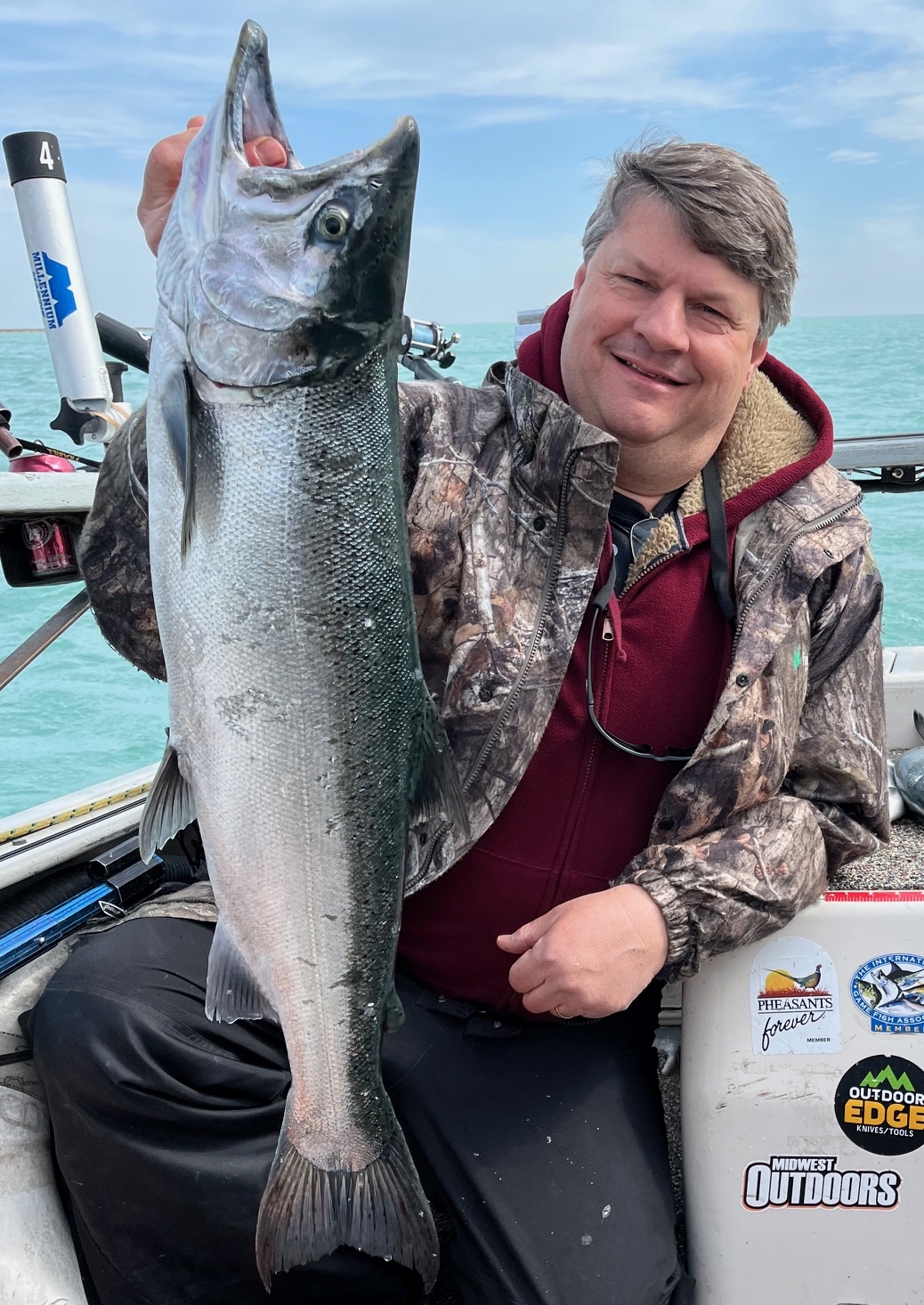
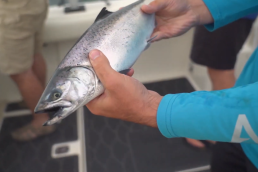
Sure, it was big—on a digital scale it showed 10.75 pounds—but when Tom was holding the fish for a photo, I noticed the anal fin was more an equilateral triangle shape, than a triangle much longer on its base than the distance from the base to the tip of the triangle, as king salmon have. A nearly equilateral-sided anal fin is a distinctive trait of coho salmon.
King salmon always have distinctive spots on their tails. This fish had only a few faint, small spots. That, too, said coho to me. The final thing that told me the fish was a whopper coho was that the fish didn’t smell like a king. Kings have a unique smell, at least to me.
I’m 99 percent sure that it’s a coho—probably one that didn’t mature, spawn and die last fall. I’ve caught both kings and cohos in the spring that were “late spawners,” identifiable by their dark, spawning colors. This fish was new-dime bright. Delayed maturity does occur, but is a rare occurrence.
If not a coho, there’s a tiny-percentage chance of it being a hybrid coho/king. It happens in the wild on the West Coast; I suppose it could happen in the Great Lakes. What do you think?
Did you enjoy this post?
You can be among the first to get the latest info on where to go, what to use and how to use it!
