
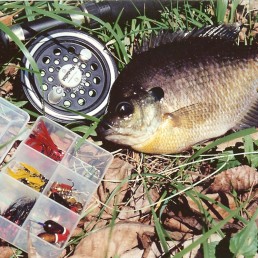
Fly Fishing for Bluegills
The tranquility of fishing a pond enhances the grace with which the fly line snakes across the water. A couple of false casts and the fly settles to the surface. A couple of tugs and the surface of the water explodes with a big bluegill sucking in the feather and steel.
Bluegills are pound for pound one the great fighters of the fish world. On a light fly line with the whippy flexibility of a fly rod they are a tremendous fish to hook and battle.
There is no real mystery to this sport once one has the basic tackle lined up. If one speaks the language of fly fishing or can find someone who does, he too can enjoy the finesse of casting a light fly or popper and fooling some unsuspecting fish into thinking it is dinner.
Fly fishing works on virtually all species of fish. Here in the MidWest, it is primarily for largemouth and smallmouth bass, trout, and bluegill and sunfish. It can also be for other species if one adapts to the situation.
There are four basic areas of tackle: the rod, the reel, lines, and lures. In addition, it is a good idea to take some instruction or view a couple of the excellent videos available. Check your local tackle shop for the fly-fishing section and ask their advice. With the right equipment and a little practice one can quickly begin.
Fly rods come in different weights with markings on the rod in numbers from one to 13. They run in lengths from 6 to 9 feet. The longer ones are usually for casting large, wind resistant lures with heavier line. Shorter rods are for fishing small streams and ponds.
Beginners are probably better off with the middle size of 6 or 7, which are good for bass and bluegill. Beginning anglers should stick to one of fiberglass rather than some of the other materials that are more expensive. A glass rod will allow one to cast medium size bass bugs, as well as small panfish bugs.
Next, one will require a reel to go on the fly rod. The reel has nothing to do with the casting in fly fishing. It is a simple, single action line holder. The spool is usually about 3/4 inch wide with a friction built in so that line does not roll off without some pull by the angler. The weight of the reel should balance the rod. It should also match the species you plan to catch. For bass and panfish, the reel will only help keep the kinks out of the fly line. Bigger fish require a different reel with drag, etc.
You can be among the first to get the latest info on where to go, what to use and how to use it!
A quality reel is a lifetime investment you can pass on to future generations. It is good to purchase the best reel you can afford.
Fly lines are of many types and weights, matching the fish the angler is seeking. The best all-around line for the beginner is a floating line. It works for bass and bluegill, as well as dry flies. Later, one can graduate to the floating line with sinking tips, slow sinking and fast sinking lines used to put flies at different depths for fish such as northern pike and walleye. Fly lines taper toward the leader end and there is only about 30 yards on the average line.
For bass bug casting, one uses weight forward line. The extra weight at the forward end of the line helps push bugs or flies. Most good rods have the size and type of line recommended for that rod written on them.
At the end of the line is the leader, which is usually about 6 to 7 feet in length. Most taper to a small size at the tippet. Knotless tapered leaders are easiest to handle. Makers mark tippet strength with an “X” number. 2X or 3X are good numbers.
For lures, begin with small bass surface bugs in plastic, cork, or deer hair for topwater panfishing. Little sinking bugs are for bluegills. Number 10 or 12 are good sizes in dry, wet, or nymph flies. Number 6, 8, or 10 are good for streamers, which are supposed to resemble minnows to the fish. As for colors, choose black and browns, or grays and white.
Once you are addicted to fly fishing, it becomes apparent that there is more to it than we are able discuss here. This will get you started in the right direction. Be aware also that this is an addictive sport that will consume your thoughts 24/7. It also is good for your blood pressure, unless you take your fishing too seriously. Then perhaps you should take up knitting.
If you want to try a different, exciting fish species or technique, you’ll find plenty of suggestions in every issue of MidWest Outdoors. Subscribe on our website.
MWO
SHARE THIS POST
Did you enjoy this post?
You can be among the first to get the latest info on where to go, what to use and how to use it!