
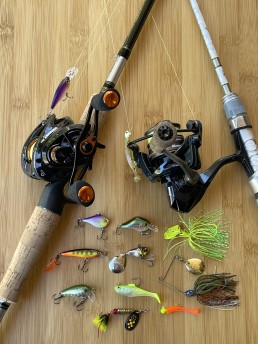
Showdown! BFS vs. Ultra-Light Spinning
Here we go with one of those “versus” ideas being raised. Why? Because y’all asked!
It’s kind of like braid vs. mono/flouro, chatterbaits vs. spinnerbaits, wind vs. no wind, Ginger vs. Mary Ann (Gilligan’s Island—for younger folks; Google it!), Bud vs. Bud Light, pineapple vs. absolutely no fruit on a pizza—you get the idea. It’s simply another earth-shattering challenge between two products or concepts, for which I have received several emails. I thought that another reader-inspired article might be appreciated. See, I read those emails! Keep ’em coming!
While ultralight spinning needs little introduction within the bass or fishing world, as the concept has been around for many years, BFS does not enjoy such a long history. If you’re new to BFS, it simply stands for Bait Finesse System. The origins seemingly comes from Japanese bass angler. It’s simply a way to present small baits—what we would consider ultra-light offerings—on a baitcasing reel; baits even down in the 1/32-ounce range.
Now, you might be thinking that as a bass angler, I have no reason to throw such small bait offerings. And for the most part, I agree. But BFS gear can be used beyond the bass fishing realm, as crappies, ‘gills, trout, and so on can also be pursued with BFS gear. Coming up, we’ll discuss the pros of ultralight presentations in some bass fishing situations and how this gear might just pique your interest.
First, a little bit of the mechanics of what makes BFS gear, well, BFS. Like I said, ultralight spinning is not new to any type of fishing. Lightweight rods, small spinning reels down in that 500 and 1000 series range, 2- to 4-pound test lines with microbaits to match, all seem pretty standard choices when very light presentations are needed for success.
Then I guess, someone decided that a baitcaster might be more appropriate to get the ultralight work done, and BFS was born. That’s my condensed version of the development of BFS gear!
The very first BFS reels I was introduced to were actually quite pricey models from the Japanese market. A fellow bank basser handed me his new arrival from Japan that, a few years ago, put him back just around $500! At that moment, I decided that my Shimano 1000 could get the job done, and I could instead make another truck payment! So, why the expense in BFS?
While on the outside, a BFS baitcaster doesn’t appear to have any noticeable differences from your standard baitcast reel, what makes a BFS work is “under the hood,” so to speak. I’m not trying to be reel expert here; you can check out on YouTub from manufacturers or other more knowledgeable reel aficionados. But BFS reels’ main differences next to standard reels come from their gearing, bearings, and probably the most noticeable to you on your first inspection, a very light and extremely shallow spool. While the other internals hide under the hard body, these spools are incredible little works of metal art. The usually-hollowed-out spools are made from the lightest metals available, and are so shallow that you’re lucky to get 80 to 90 yards of line on them. Little tweaks of the internals are what I’m told drives up the prices of these reels.
While the very first BFS gear made its appearance with rather heavy price tags, as the interest grew among anglers, reel manufacturers took notice and began expanding their baitcast models within the BFS arena, producing more affordable models under their brands. Like I said, many early models from the Japanese market were touching the $500 mark, and you can still shell out the bucks if you so desire, but models under the $100 price point are out there now.
Talking to few anglers much more knowledgeable concerning BFS gear, they stand their ground and claim that the very best in BFS comes with a high price tag. I’m not going to dispute their opinions; with any fishing gear, for that matter, generally the more money you put out, the more advanced and sensitive the gear normally is. You must decide if these high price points fit within your personal spending range. That becomes a matter of choice. But I assure you that you can get into BFS gear at reasonable prices if you just want to experiment with the system without taking out a second mortgage! I’ll discuss a few choices shortly.
You can be among the first to get the latest info on where to go, what to use and how to use it!
First, though, do you really need BFS gear? This article is not meant to sway anybody’s choice to jump on the BFS bandwagon or not. Rather, I’m going to give my honest opinion as it applies to my style of fishing—highlight on “my style” of fishing. Is BFS gear a staple when I head out targeting bass or any other species? I have to admit that it is not. But, with all the interest and media presence, I decided to give BFS gear at least a try and run it through the rigors of my style of fishing over the last year. So, it’s not an overnight or one-shot experience used to form my opinion.
Now, to start off, I didn’t go all-in with high-priced BFS reels. Some BFS fanatics will point out that I didn’t get the full experience without at least reels in that $300-plus range. Sorry, I’m not putting out the money with the uncertainty of the system for my angling. I did check on some reviews within the industry, and with a few friends who couldn’t talk me into more expensive gear. I settled on an Ark Gravity BFS and a couple or reels from Kast King—the Kestrel BFS and the Zephyr BFS—in the $80 to 150 range. I know they’re not top-of-the-line, which I’m sure I’ll hear about.
Match these reels up with light baitcasting rods, which you do need with BFS reels to get the full effect of the system. It’s not just the reel, but these rods, which I already had. During my experimenting, I used several line types and strengths, both mono and braid: basically 2- to 4-pound mono and braids ranging from 6- to 8-pound—both extremely low-diameter lines. Bait-wise, I threw all the micro and light baits that I normally reserve for my ultralight spinning gear, and used the BFS gear under many fishing conditions, on all types of waters that I frequent.
Conclusions? They certainly are mixed. Honestly, I liked the BFS reels that I chose, and they performed as promised by the manufacturers, and had no issues with any of them. Did they cast the small baits, even down to the micro presentations? Almost without failure, I felt that a few baits were best suited for a spinning reel presentation: mostly ultra-small jigs. But the BFS reel could cast weights down to 1/32-ounce, as claimed. So, it’s not that the BFS couldn’t make the cast. I’m just more comfortable with spinning gear. It could be just a lack of practice. For me, I will stick with my ultra-light spinning gear for very light jigs and soft plastics.
Pros for the BFS gear came from working micro and ultra-small and light-weight crankbaits, and small spinnerbaits and chatterbait presentations. It’s not so much the ability to cast, but that the reel design of the BFS baitcaster allows a smaller amount of line retrieve per turn of the reel handle during the cast. Therefore, I had much more control over lure speed when using these BFS reels. That can be accomplished with a spinning reel as well, but you need to concentrate on keeping your reeling speed under control. It’s easier, I feel, with the baitcaster.
Some claim much better line management with BFS over spinning reels, especially with mono or fluorocarbon, as the baitcaster is less prone to line twist. I’m undecided on that theory, as I don’t have a lot of issues with line twist, no matter which reel I use. Speaking of line management, BFS reels have extremely low line capacities; for this, I am certainly a fan. The smaller spool practically eliminates backlashes—almost—although it’s much easier to clear if you happen to experience one. I had very few, to be honest.
One of the biggest accolades for BFS gear is accuracy for casting small baits. While this might be true for many BFS enthusiasts, I found myself every bit as accurate with my spinning gear. I know that it’s a matter of practice and familiarity with the system, but BFS is not the only type of gear I use, so my abilities and skill level will probably remain the same.
Now, the Final Conclusion! After all the hype for BFS… it’s a fun system to use! If you are totally a baitcasting angler, then BFS is certainly right for you. I’m a diehard spinning guy; I use baitcasters at times because they’re a better tool for that particular approach. But if I can, I’ll always lean toward my spinning gear. The BFS gear, for me, really shines on smaller waters, ponds, creeks, and small river situations—especially areas with limited casting room, such as low-hanging trees and tight quarters. Little sideways casts and flips prove their worth, for sure.
Will I continue to use my BFS? Of course. But for my style of fishing, it will be limited. My advice to youis, if you want to give it a try, check out the lower-price-range BFS gear mentioned in this article, or send me an email for some extra guidance. Just remember, don’t go too cheap; there are some real low-end models out there online that will do nothing but frustrate you!
The BFS market is a strong one. I feel that it’s a niche fishing approach for most anglers, myself certainly included. But who knows? You could easily be drawn into this whole BFS craze! It all comes down to time on the water, not the gear. Find and fish whatever system draws you to the water’s edge!
Did you enjoy this post?
You can be among the first to get the latest info on where to go, what to use and how to use it!