
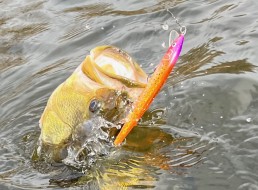
Marsh Madness!
“In like a lion, out like a lamb.” Whoever first coined that saying for the month of March was not from Michigan. Our version might instead be, “In like a glacier, out like a mud slide.” March weather isn’t often pretty in our state, but the fishing can still be pretty darn good.
Plenty has been written about spring steelhead, walleyes and other early-season opportunities in our state, so let me focus on a different pattern emerging in March, at least in southern Michigan. Further north, it’s the same deal, but begins later, in April or even May, considering the major climate differences from the southern lower to northern upper peninsulas.
In the weeks following ice-out, lake and river areas near and in adjacent marshes are the first places to spring to life. They typically feature darker bottoms with dead vegetation matter that warms first; are often somewhat sheltered from the main, colder water body; and many feature an incoming tributary that brings fresher water into the system after a long winter of declining oxygen levels.
They are where the bottom of the food chain—whatever microorganisms and such initially become most abundant—and the rest of the food chain, from the smallest baitfish on up to big predators, tend to collect. It becomes a fun, multi-species opportunity, especially for largemouth bass and pike as the most prevalent predators on many waters, along with bonus fish as muskies where they exist. And brawny bowfin, too.
Year-round catch-and-immediate-release of bass and muskies in Michigan makes it legal to pursue these fish in the earliest weeks of open water, but note that it’s not officially authorized for northern pike during their relatively brief closed season. This may eventually be revised, but for now, bass, or muskies if available, are the main predators to target during the closed pike season. However, where pike are present, it’s still advisable to use light wire or quality fluorocarbon leaders, even if you’re after bass.
Major marsh areas
Depending on where you’re fishing, shallow, marshy areas can still cover a lot of territory, so it helps to narrow it down to the best spots you can find in a given system. As mentioned, some protection from the cold, main lake or river helps, like a narrower entrance that serves as a pinch point for fish moving in and out. With or without that, a bit deeper water within a marshy bay or area helps, too. Such spots hold fish in bad weather, although these predators will still use marshy areas far from deep water, especially in good conditions.
A tributary entering the area is a plus, although not a necessity. The main draw is still places that are the first to warm a bit, given their shallow nature and bottom composition. Old lily pads and their roots, dead reeds, especially where they are more concentrated, and whatever remnant vegetation is present provides some cover in the warming, but still relatively cold water.
Then, when there is a warmer weather stretch (finally!), it’s remarkable how quickly a bit of green life can begin, often starting out with new pads. Any new vegetation brings fresh cover, more oxygen, and is a top place to target. Also, note that whatever the weather is when you go, the warmest part of the day—late morning to afternoon—typically sees the most fish activity.
You can be among the first to get the latest info on where to go, what to use and how to use it!
On heavily developed lakes that have man-made boat channels, these areas tend to be shallow with dark bottoms, warm early, and can essentially serve as adjacent marshes with old weeds during the start of early growth. Some include actual marshy portions along their banks as well, too low-lying to develop when the channels were made, and these can be prime areas.
Marshaling top tactics
This is mostly very shallow fishing, with sparse cover very early in the year, featuring cold but slowly warming water from the low 40s up to the low 50s. Baits that perform well in as little as a foot of water, usually not more than four feet, and at slow speeds, are the ticket. Plus, it’s best if they don’t sink fully down into the softy, mucky bottoms that most marshy areas have.
Suspending, hard-body jerkbaits, and soft versions like jerk shads or swim baits, are top bets, especially for multi-species appeal. Other specialized soft plastics for bass, or very large shallow options for muskies, also work, but it can be more fun to use what has the best chance of getting bit by whatever predators you encounter. Regardless of the bait, trying for the best, neutrally balanced, suspending look tends to be optimal, especially in the earliest weeks after ice-out, with water temps in the 40s.
You can experiment with hook sizes, and how many hooks—like removing the middle treble on hard baits with three, and using lightly weighted hooks on soft floating jerk shads—to get them to hang there perfectly, or float up very slowly. With trebles, you can also cut off one tine of each to fine-tune their neutral balance. Removing the front tine helps grab less junk that the lure bumps into. Slowly-descending baits should be avoided; in such skinny water, they get down into the marsh mush too easily.
Retrieves during the coldest-water portion of early season can be just tugs of a few inches to work best, with long pauses. Watch your line closely; takes can be as soft as the bottom in these areas. When in doubt, set the hook!
When water temps get around 50, more presentation options emerge. Smallish in-line spinners that stay up in the water column can be great; glide baits and lighter spoons that stay up high, too. Try spinnerbaits, usually with Colorado blades to keep them shallow at slow speeds. There are lots of options. Soft plastic swim baits and jerk shads continue as top bets, especially rigged relatively snagless when early weed growth begins.
Later, in water from the mid-50s on up, most everything else is fair game, too, including topwater lures—the most fun way to fish shallow, warming waters. But that’s beyond the scope of this discussion, since your humble author could quickly accumulate too ridiculous a word count for one article.
Please be easy on the fish when enjoying the early catch-and-release season, including keeping them in the water as much as possible and handling them quickly but carefully. In or near spawning time, depending on the species, it helps the resource when that is more successful. Plus, if we choose to keep a modest bass or pike or two when they’re legal later on, they’ll be ready and waiting for us!

Did you enjoy this post?
You can be among the first to get the latest info on where to go, what to use and how to use it!
