
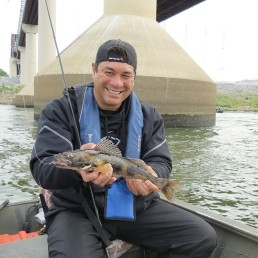
Early-Season Sauger Fishing
The last dying days of winter are the best ones for finding and catching saugers. Saugers are present throughout numerous river systems during most of the year. Each spring, they migrate to the area below locks and dams. The fish are there for about a month from roughly mid-February to mid-March. Water temperatures trigger fish movement when they reach 45 to 53 degrees.
A word about safety is important. If a river floods and fast-moving water poses a danger, then it is advisable to fish only from shore. No fish is worth a life. Often, it is illegal to fish within 150 feet of the lower edge of the dam to prevent boat accidents and drowning.
The sauger is a cool-water, river-run cousin of the walleye. Both are members of the perch family. Both have an opaque, silver color to their eyes. This is due to a special layer of light-gathering tissue that enables them to be active in low-light conditions.
Saugers looks very much like walleyes, but they have several rows of distinct, black spots on the dorsal fin. The overall coloration is grayish to brownish with dark blotches. The body of a sauger is typically slimmer than that of the walleye, giving it a cigar-like shape.
A bottom dweller, the sauger is basically a minnow-eating machine feasting on small baitfish, even during the spawn.
Black jigs are popular with river anglers in search of saugers. The rule of thumb is to use a jig color that sharply contrasts with whatever water color you are fishing.
During the cold days of February, tight lining a jig and minnow combination is popular. Begin with a heavy jig that will stay down and offer a feel of the bottom in heavy current. Something 5/8-ounce to a full ounce is good. Round heads seem to be best in rivers. Jigs dressed with natural hair, soft plastic grub body, or any other material all produce.
The jig head should be a bright color such as orange or chartreuse. The color of the jig is important to supply flash to the bait. The minnow supplies the taste that saugers are seeking.
Place a jig hook through the lip or eye of a minnow. Add a trailer hook to the tail of the minnow for extra effectiveness with short-striking fish.
Lower the rig to the bottom and take up slack, allowing the bait to bounce and wiggle along. If drifting in a boat, allow the bait to ride straight down. Maintaining a tight line permits you to feel the characteristically light bite of the sauger—just a tick on the line.
You can be among the first to get the latest info on where to go, what to use and how to use it!
Rod and reel combinations for sauger fishing are a matter of personal preference. For trolling crankbaits or three-way rigs near bottom, most anglers use baitcast reels on graphite rods, due to their sensitivity. Most prefer using monofilament line in the 10- to 12-pound class. It is strong enough for battling fish in fast-running water and yet still detect a light bite.
For fishing jigs, spinning gear is generally preferred since it performs well with lighter, 6- to 8-pound lines. Given that saugers usually prefer areas with stronger current than walleyes and that heavier jigs may be required to fish these spots, 8- to even 10-pound line may be a better choice.
Eddies below dams often contain fish, and the rocks below dams create an eddy effect that slows the water downstream. Fish move to these areas to stage and rest from fighting the current. Yet they can still move out to feed on forage fish moving past in the current.
Biologists tell us that saugers prefer rocky areas in less than 10 feet of water during the winter spawning season.
Anglers in boats drift past these areas, allowing theirs baits to pass into the eddies. Whether you’re a shore or boat-based angler, the techniques remain the same. Cast a quartering shot upstream and slowly guide the bait through the eddy or other slack-water area. When one fish takes the bait, cast back into the same area, as fish tend to group in such areas.
The best days for saugers tend to be cold with gray skies. A bit of rain or snow does not diminish your chances of taking good fish. It can expand the quality fishing time to include the midday period as well as early and late in the day.
Tired of winter? Want to get into the fishing mode again? Try sauger fishing.
If you want to try a different, exciting fish species or technique, you’ll find plenty of suggestions in every issue of MidWest Outdoors. Subscribe on our website.
MWO
SHARE THIS POST
Did you enjoy this post?
You can be among the first to get the latest info on where to go, what to use and how to use it!