
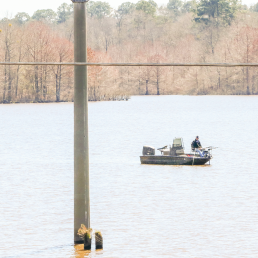
Crappie Tips for the New Year
Give yourself the best opportunity to catch crappies in 2026. The following tips don’t guarantee success, but they can increase your odds of putting fish in the cooler.
Smelling good makes a difference
(Your bait, not you!) You can catch fish with a jig without using an attractant or scent, but you’ll likely catch more fish if you use sprays, liquids, gels, and dough pellets. Berkley Crappie Nibbles have been around for decades for getting more bites. When the bite is bad, you can also use them with live bait to entice a few more bites.
Forward-facing sonar is today’s high-tech electronics
Older fishermen often struggle because it’s basically like a complicated video game. However, young fishermen pick it up quickly because they’ve spent so much time playing video games. Experts say that learning to use it is worth the effort and costs, paying off in more and bigger fish. If you’re in for a game, give it a try.
Make your tacklebox skinnier
Every year, it’s good to empty your tackleboxes, wash them thoroughly, and let them dry. Have a spare box or other container on hand for leftover baits and other miscellaneous items. Go through everything. If you’ve used something like a specific jig and you will use it again, keep it. If not, it goes in the other box for storage. Proceed with everything until you’ve cleaned all your tackleboxes. Do the same with compartments in the boat. You’ll end up with an uncluttered boat and tackleboxes and be able to quickly find things you need.
While cleaning, clean and check your rods and reels
Replace or repair broken items. Change line if needed. Check everything on your boat, too. Remove things you don’t use.
You can be among the first to get the latest info on where to go, what to use and how to use it!
Slip-float and minnow rig
A slip-float and minnow rig is good in almost any situation for both novice and expert fishermen. The simple rig consists of a minnow hook, split-shot, slip-float, and bobber stop. The bobber-stop on the line sets the depth of the bait. A minnow does the work of enticing bites. On the cast or pitch, the line is pulled down by the sinker until the bobber-stop reaches the float. The rig can be dropped straight down or casted. It stays in one place in calm water, while a slight wind or current pushes it slowly along. The ideal situation is to cast upwind or up current and let the rig float naturally into the target area. Using a minnow is ideal because it does all the work and catches bonus fish, too.
Match line size to the situation
Use 8- or-10-pound line in a lake with lots of cover and a history of heavy crappies. A lake with small and medium-size crappies, along with a lot of fishable water with little or no cover, means line size should be 4- or 6-pound-test. Using the right line size is directly proportional to the number of fish you’ll catch, with 6-pound-test the best all-around line size. Also match bait size to season, water visibility, and fish aggressiveness. Note: Many northern waters are clear with limited cover, so downsizing to 4-pound-test line can be a good idea.
It’s better to have a little wind than no wind at all
Fishing in the wind is a situation that all fishermen face. Calm water is usually difficult to fish because crappies are spookier. Calm water may be comfortable, but it’s difficult fishing. A small ripple is ideal. The ripple helps hide the boat, plus arm, body and pole movements. You can get closer to the fish without spooking them. Strong winds become a problem. Boat control is often the biggest problem, with wind breaks becoming important. You will likely need to go to heavier weights to keep baits down and to reduce the bow in your line.
Brushpiles and laydowns are excellent covers to fish
When either are in mid-depth or deep water, they can be year-round crappie hangouts. However, shallow wood cover is good in spring and during certain times in other seasons. Brushpiles that come up to within 5 feet of the surface can be fished with a fixed float and jig or minnow. Move the bait slowly and let it rest. Fish are often in the top of brush or laydown and will come out and take a bait. Fish the rig slowly. You may prefer to cast without a float, too. Take care to keep the jig just above cover to avoid hang-ups. When things work out, you’ll have good action with multiple bites at each spot.
Stick to basics
Doing the basic things correctly eliminates most mistakes and increases your fishing action and fun. It may not be as easy as it sounds, a little thought and action pays big rewards.
Get better results from the time you spend fishing. Use information from the pros found in every issue of MidWest Outdoors, available by subscribing on our website.
MWO
SHARE THIS POST
Did you enjoy this post?
You can be among the first to get the latest info on where to go, what to use and how to use it!