
Nab Nippy Weather Cats
written by Gary Nelson and previously published in Fishing Facts Nov/Dec 2010
You lower a red marabou jig that’s been doused with some bottled fish attractant and vertically fish it near the bottom of the lake, about 30 feet down. The jig stays untouched for about four minutes, then suddenly you feel a light tap. You set the hook, and a minute or two later you reel in a cold 2-pound channel cat—a fine fish for the table.
When the water temperature is kind of nippy in mid- to late fall and again in early to mid-spring, many catfish will still be doing some biting. A bait on a standard hook-and-sinker rig will certainly catch them, but the fish can be caught with a jig during these periods too, especially if the jig has been dunked in some fish-attracting scent, such as bottled crayfish or shad flavored attractant. Everyone knows catfish habitually feed by smell.
The use of a jig can offer an advantage over using a regular bait hook/sinker rig. With a lead head jig, the “sinker” (the lead head) is positioned right at the bait. Thus, you often feel the bite more quickly than when there’s a sinker up the line between the bait and your rod tip.
Another possible advantage of a jig is that it can be moved slowly with a little less chance of getting snagged; a hook and sinker rig has two components that can hang up. While a jig can be successfully still-fished too, moving the jig slowly along bottom will put the offering closer to more of the catfish that are part of a loosely congregated “school.” (The cats won’t be moving around like they did in summer or early fall; they won’t move as far to find a bait.) While you move the jig, you can also occasionally hit the bottom with the jig head to add some sound, an added attraction.
A 1/8-ounce jig is fitting for many cold-water situations. A marabou one is a good choice as it will hold a lot of liquid attractant. Or a tube jig can be employed; its cavity can be filled with attractant. The color of the jig doesn’t matter much since catfish mainly find food by smell. This writer accumulates plenty of jigs in colors (like red or purple) and color patterns that I don’t often use when fishing for other species. I use them for catfishing and they seem to work well.
An alternative is to sue an undressed jig hook and onto it, tip a piece of standard catfish bait. The bait might be a nightcrawler or half a nightcrawler, forage fish (cut bait or a live minnow), or a piece of turkey or chicken liver. Like a marabou jig, the bait-tipped jig hook can be cast and very slowly retrieved near bottom through the group of catfish. It’s also a good offering for vertical still-fishing. The hook point needs to be left exposed for a better chance of a hook-up.
And, the hook needn’t be large. In fact, a smaller hook will be more easily taken in, and less noticed, by a catfish. A number 6 will catch most average-size channel cats. Some prefer a jig hook that has a painted head, as a cat might more quickly reject the taste of the uncovered lead.
You can be among the first to get the latest info on where to go, what to use and how to use it!
The fishing line used should be about 6-pound test or a little heavier if the cats are running big. A medium or heavy spinning outfit is fitting.
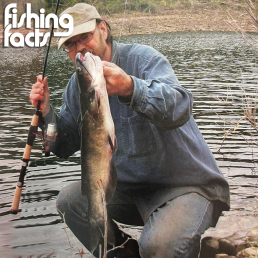
The best cat species to target when the water gets nippy is usually the channel cat. Other species, with the exemption of the less abundant blue catfish, get a little too dormant. The channel cat is known to feed a bit even in the middle of winter in northern regions, but the action is better if you do your fishing before or after the period of coldest water. Forty-five- or 50-degree water in fall or spring is much better than wintry 35-degree water. Of course, in southern localities, angling success can be had further into winter.
The trick with jig fishing for channel cats is to get your offering as close to the group of cats as possible, since they won’t be roaming around as much. In a river situation, the cats will often be positioned in deep holes and in or behind good-sized cover that slows down or stops the current. This might be a big underwater log, log jam, a huge boulder, or a group of big rocks. (In both rivers and lakes, it’s best to stay away from bottoms piled with dead aquatic plants or other organic matter. This material consumes oxygen, which the cats need. A bottom consisting of sand, gravel or small rocks is appropriate.) In a river, the jig can be cast out so that it will drift and settle into a deep hole, then very slowly retrieve it.
In reservoirs or naturals lakes, think deep water. The channel cats might be swimming in 25-foot water or even 50 feet in the clearer, deeper water bodies. In reservoirs, they’ll often take up residence in an old creek channel bed. At natural lakes, look for deep holes, humps that rise slightly up from a deep bottom, and deep drop-offs. Again, the fish will often seek heavy cover and will often be lying at the base of it. A sonar unit can help pinpoint it. If legal, it helps to chum a spot at the lake (or river) with a variety of catfish forage for at least a few days in a row. Then you’ll know exactly where to fish.
At a lake or reservoir, the jig can be cast out and slowly worked near the base of the cover. Or the jig can be vertically lowered then still-fished at or near bottom from a boat, bridge or deep-water dock. When vertical fishing, keeping the jig suspended several inches up off the bottom is often the best approach. This way the scent is dispersed a little more and, though catfish don’t have great eyesight, the offering is more visible. Or try a few feet above the bottom. Cats that are hovering at a slightly shallower depth than the other cats tend to be more active feeders.
If boat fishing, it usually pays to put out an anchor at a prospective spot unless it’s really calm. A breeze can cause your offering to move too fast for the catfish.
Cold-water bank fishing can be practical, especially at rivers. It’s possible to have success at reservoirs from the shore, too, especially if you focus on a deep-water creek channel that swings close to the bank.
Cats have a reputation as being night feeders but will certainly hit jigs and bait-tipped jig heads during the day, too, even midday. Go out when you can, to battle a good-tasting channel cat from that nippy water.
MWO
SHARE THIS POST
Did you enjoy this post?
You can be among the first to get the latest info on where to go, what to use and how to use it!
