
River Bass via Crankbaits
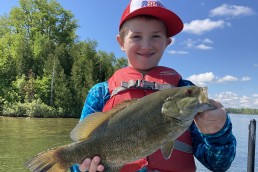
In summer, Steve Mattson recommends casting crankbaits for river smallmouths.
There is just something about moving water and bass. Their compact design makes them well suited to cover water and adjust quickly to moving food. They also are some of the feistiest fish once they learn that they are hooked, with aerobatics and using the current to their advantage. These fish learn quickly that even though the water is always moving, there are still calm areas to find reprieve.
Bigger rocks or rocky areas can be great spots, as they stop and redirect the current. Depending on the size of the rocky area, slack water could be found in front of, behind or even on the side of the obstructions. Wing dams, trees, logs and even a single good-sized boulder is all a fish needs to find some relief from the current. As ambush predators, they lie in the eddy and wait for the next opportunity that comes washing by. Crawfish, bugs and minnows also try to take advantage of any crevice to hide and take cover. Finding several of these areas in rivers can be a key for consistent action throughout the day.
Due to the constant flow of water, most rivers have an abundance of firm or hard bottom. Most times you will find good structural changes near tributaries or bends in the river. But even in straight stretches, there will always be nuances that attract fish.
It usually takes a little time to find the areas that not only have the ingredients but also the fish. Covering water via shore or in the boat is critically important to find these good areas. Crankbaits were born for this opportunity. Most crankbaits have a compact design and function very well in moving water.
Lipped designs
Choose your crankbait based on the depth of the river you will be fishing. Most of the time, you will be targeting less than 8 feet of water, making shallow- to mid-diving options the best choices. Baits such as the Rapala DT in size 4 or 6, Rapala Shad Rap, and Luhr Jensen Speed Trap all produce a tighter wobble and fish very well in current. Cast it down current, side current or even up current, and the crankbait’s action will be true. For a more aggressive, wider wobble, Storm Wiggle Warts are also longtime favorites of many tournament pros. The small, compact design works well in current.
You can be among the first to get the latest info on where to go, what to use and how to use it!
Crankbaits that have rattles can help as the extra noise it produces helps fish zero in on it better in moving water. As stated, choose a crankbait that can reach the target depth. Using a crankbait that dives 14 feet when you are in 6 feet of water will constantly get snagged, and that is not fun in rivers.
Lipless designs
To avoid the issue of diving too deep, lipless crankbaits allow you to vary the depth based on your retrieve speed and technique. Baits like the Rattlin’ Rap, Rippin’ Rap and Storm Arashi Vibe give you a lot of options in moving water. You can cast them a country mile and fish them in variety of different ways. Due to their design, you will be able to cover more water. But they will only catch the active fish, as you need to keep them moving to prevent them from being snagged. Great locales for these are long stretches of flats or no change in bottom. Fish will be scattered in these areas, and these baits allow you to cover water to find them.
When you catch a fish, always pay attention to where and how the fish hit the lure. Try to duplicate that in other areas, being careful to maintain the same retrieve speed. Oftentimes, there was some type of eddy nearby. Cast into the upstream eddy first (slack water immediately before the structure.) When actively feeding, fish can school up on these areas. The next logical cast should be on the sweet spot where slack water is tight to really fast current. Hungry, active fish are often right there at the ready. The most common location to cast is the downstream eddy. This is the place where schools can congregate, as it gives many fish the opportunity to remain in slack water with some room to roam. Make multiple casts to this area for an extended period. Anchors, powerful trolling motors or power-pole anchors will all help you dissect the spot.
Rivers can be a little bit tricky to fish but be extremely fun and productive. They also seem to be less susceptible to weather changes and reset much quicker than lakes can. Use that to your advantage to ensure that you stay connected with more summertime bass.
Looking for more ways to increase your catch rate? You’ll find plenty of suggestion in every issue of MidWest Outdoors. Subscribe on our website.
MWO
SHARE THIS POST
Did you enjoy this post?
You can be among the first to get the latest info on where to go, what to use and how to use it!