
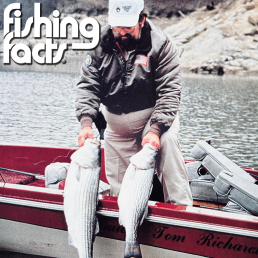
A Winning Strategy for Cold-Water Stripers
written by Don Kirk and previously published in Fishing Facts March 1992
The boat dropping from its high-speed plane position stopped the brisk wind from cutting into my face. It was not until we slowed down that I noticed how hard I was shivering. Feeling something hard in my mouth, I discovered my chattering teeth had dislodged an old, grade-school filling from a molar.
“Cold?” chirped Tom Richards, as he bounced to the front of the boat to drop his trolling motor.
“Not a bit,” I said, while attempting to control my jerking body parts.
Tennessee’s Norris Lake was ours. At least, as much as we could see of the 35,000-acre impoundment appeared to be our private fishing hole. Like all Tennessee Valley Authority impoundments, Norris Lake was at winter pool level. A 70-foot-wide band of red clay and rock separated the choppy waters of the lake and the tree-edged, full pool shoreline.
Throwing a switch, Richards fed power into his Eagle depth finder. During cold weather, stripers can be depended upon to frequent certain areas of a lake, but their exact holding locations must be pinpointed. Systematically searching for them, we cruised slowly along an old feeder creek that entered the main body of the impoundment.
Only weeks before, these large-growing game fish were concentrated in the upper reaches of the man-made lake. Cooling temperatures had brought them downstream to Norris Lake’s deeper mid-reaches. With half a lifetime spent pursuing linesides at Norris and other lakes in the Southeast, Richards had learned that when the temperature dipped low, these gamesters would be located in this pocket of the reservoir.
We were 150 yards from the nearest shoreline, a far cry from the narrow, gorge-like areas we had successfully fished a month before. The area we now scanned showed little in the way of cover, other than a few stump beds and clay/shale drop-offs and humps. However, in cold weather, stripers prefer this neighborhood because it provides them with easy access to slightly warmer, deep water. Equally important, schools of shad also are common in the somewhat warmer, mid-reaches of the lake.
Slowly searching in a checkerboard fashion, we marked schools of stripers by tossing out bright orange marker buoys. After 15 minutes, we had graphed five schools of stripers suspended or resting on the bottom of the lake, near an old river channel. The graph also revealed the presence of many schools of baitfish that appeared like smoke-like blurs on the graph paper.
Most of the stripers noted on the graph were 10 to 12 feet deep, but some of the larger arches noted on the graph paper appeared to be right on the bottom at depths of 16 to 21 feet. It was exactly what Richards anticipated.
“When surface temperatures reach the 40-degree F level or colder, these fish seek out deeper zones in the 50-degree F range, precisely as these arches show. Let’s see if we can interest these fish in some bite-sized live bait,” explained Richards as he readied a pile of rods from which sinkers and bare hooks dangled.
Maturing as an angler in eastern Tennessee from the mid-1960s through the 1970s, I have seen many significant changes in the ways anglers attempt to catch landlocked striped bass. For years, everyone thought these shad-eating critters could only be caught on live bluegills unless, of course, you were trolling a white bucktail tipped with a pearl-colored plastic worm.
By the early 1980s, fishing big, live shad and cut bait became popular at impoundments throughout the region where striped bass and whiterock (hybrid) fisheries were established. Surface action was refined, especially during spring’s so-called “Redfin Season,” as was casting spoons into surface feeding action.
More than I, Tom Richards has been on the cutting edge of ever-changing methods for catching the South’s leviathan linesides. Perfecting numerous crankbait techniques for night fishing, he has caught more than ten striped bass in excess of 50 pounds on artificial baits. However, like many anglers, Richards was often frustrated by the reticent behavior of these fish during frigid weather.
Experimenting with many sizes of bait under these circumstances, he discovered that striped bass exhibit predictable preferences for smallish, bite-sized foods when water and air temperatures send the mercury down past freezing. His discovery not only apples to live bait, but artificials as well.
You can be among the first to get the latest info on where to go, what to use and how to use it!
“Unlike humans (and many other mammals) that consume additional quantities of food when confronted with cold environments, striped bass are cold-blooded creatures. These fish respond to low temperatures with a reduced rate of metabolism.
“Lowered metabolic rates not only mean they eat less; it also means their internal functions operate at reduced rates. Under most conditions, a 40-pound striper would prefer an 8- to 10-inch gizzard shad. However, during cold weather, they more effectively digest smaller foods, and instinctively key their feeding efforts to considerably smaller baitfish,” explains Richards, a full-time fishing guide.
Richards accidentally discovered that giant-sized stripers prefer small baits in cold weather over a decade ago while angling for walleyes at Tennessee’s Norris Lake. When fishing submerged creek drop-offs during a cold snap in winter, he was using 3-inch minnows typically used at this time to catch these fish. Within an exciting 2-hour period, he hooked and landed five striped bass weighing 25 to 45 pounds.
When bait fishing for late-winter stripers in reservoir impoundments, Richards uses two basic techniques: 1) Drift fishing with four to five lines suspended vertically over the side of the boat, and 2) free-drifting lines that trail 80 to 100 feet behind the boat. “Outlines,” as he calls such trailers, are universally popular among the most experienced striper anglers.
Richards also uses more active approaches for catching cold-weather stripers at Norris, Boone, Cumberland, and Cherokee lakes. Once located over definable cover, such as clay/rock humps, along drop-offs or other similar spots, he likes to cast minnows across the area where his quarry lurks. He then retrieves them slowly across the bottom at the level where the stripers are located.
Artificials work, too!
An identical ploy is used for catching big, cold-weather linesides on medium-sized, 1/2-ounce, leadhead jigs. Cast across the spots where schools of stripers have been marked on a depth finder. Then present these baits with short, jerky retrieves. Basic white, spruced up with reds, greens and bright yellows, are Richards’ favorite cold-weather jig colors.
Leadhead jigs are not this skilled angler’s only cold-weather hardware offering, especially when stripers are in shallow, 1- to 8-foot depths. Many newcomers to striped bass fishing in manmade lakes are surprised to discover that surface action is not uncommon throughout the winter, even when the mercury dips below the 10-degree mark.
“Surface feeding action often occurs in diminished light, like shortly before dark, at sunrise, and on very overcast days. My favorite way to catch them then is to start with chrome-colored, Bill Lewis Rat-L-Traps. One of the best known and top crankbaits made anywhere, Rat-L-Traps have long been a secret weapon of mine,” explains Richards, who spends his weekends in the sporting goods department of Walmart stores, telling people how to catch fish, especially striped bass.
“There are two ways to use lipless, vibrating crankbaits on breaking stripers. One is by casting a floating model across to where fish can be seen ripping the surface. Surface models are most effective when retrieved slowly so that they are easily detected as V-like ripples follow the bait.
“The second method is to cast chrome diving models of these crankbaits. When stripers are visible near the surface and feeding on shad, only some of the available fish attack top-side baitfish. Bigger stripers locate beneath this topwater action. Being energy-conscious, they gorge on dead and injured baitfish drifting to the bottom. Sinking models of lipless, vibrating crankbaits can be fished at any depth by “counting them down” before retrieving,” notes Richards, who is fond of all chrome models of these versatile crankbaits.
When stripers are located 2 to 5 feet deep, Richards also like to cast chrome-finished Storm Thunderstick crankbaits. A well-designed, ruggedly built bait, Thundersticks perform well on winter and spring-season stripers and hybrids. When pulled slowly through the water, these slender baits effectively mimic the swimming motion of an injured baitfish.
“During cold weather, stripers are even more opportunistic than at any other time. They have great difficulty resisting easy meals, such as injured baitfish. Storm’s clear-finish Thunder Mac, jerked across the surface, is one of the most productive cold-weather baits ever made for luring 5-foot-deep linesides to the surface,” says Richards. Although this guide learned to catch striped bass by using live bait, he has become an expert in the many ways of taking these tackle-busting fish on artificials.
The rigors of cold-weather fishing are often the biggest drawbacks to planning a “striper safari” to your favorite lineside lake. Next time out, think small for big striped bass and hybrid action.
You’ll find information on what’s happening in the world of fishing and hunting in every issue of MidWest Outdoors, available by subscribing on our website.
MWO
SHARE THIS POST
Did you enjoy this post?
You can be among the first to get the latest info on where to go, what to use and how to use it!
